

It is around this time of year that the presidential invitation(s) to Fellow of Engineers Ireland are announced by the outgoing President. An event that has somehow over the past decade, been overshadowed by what would appear to be a bout of self-indulgence.
While it may be difficult to see the immediate merits of awarding such an exclusive title to a gastrointestinal surgeon, perhaps the observed practice in more recent years of inviting those involved in energy generation, flood management and environmental protection could be interpreted as being more intentional.
The following options are at the discretion of the President of Engineers Ireland:
The invitation to Fellow by the President may be made to “certain persons whose election would, in the opinion of the Council of Engineers Ireland, advance the interests of Engineers Ireland”.[1] In the normal procedure[2] for this title, it is a prerequisite that candidates already have the Registered Title of Chartered Engineer.
The invitation to Honorary Fellow by the President “shall be a person who is distinguished by the importance of his/her work in engineering, science or otherwise, whom Engineers Ireland desires to honour”.[3]
Engineers Ireland is a Qualifications-Based Organisation
The Registered Title of Chartered Engineer is the only engineering title that has statutory protection in Ireland. The Institution of Engineers of Ireland, whose operating name is Engineers Ireland was afforded this privilege by The Institution of Civil Engineers (Charter Amendment) Act, 1969. Engineers Ireland has the responsibility for setting the criteria to obtain the title ‘Chartered Engineer’ and to maintain appropriate standards.[4] Therefore, the continuance of the privileged autonomy Engineers Ireland enjoys is contingent on maintaining the confidence of the government and the public in its governance arrangements.
The process to Registered Titles in Engineers Ireland is well defined. In particular, the award of Chartered Engineer requires a sufficient level of knowledge, experience and responsibility in key competencies, along with a demonstration of the necessary awareness of the Bye-laws and Code of Ethics.
Engineers Ireland, according to its website, “is a qualification-based membership organisation that needs to confirm you completed your qualification before you can be considered for full membership (“MIEI” stands for Member of Institution of Engineers Ireland) by our Membership Qualification Board (MQB).” The following are some of the bodies established by the Executive Board engaged in these duties:
“On behalf of Council, the Membership and Qualification Board is responsible for the development, establishment and implementation of the policies, regulations and procedures required for the implementation of the Council’s statutory functions and obligations in respect of the Register and all other matters related to the membership grades and professional titles of Engineers Ireland.[5]”
“On behalf of Council, the Board [of Examiners] is responsible for the supervision and quality assurance of the Professional Review procedures leading to the award of the Registered Professional Titles of Engineers Ireland to qualified candidates.[6]”
Governance Practices at Engineers Ireland
Governance by way of regulations regarding the Engineers Ireland Presidential Invitation to Fellow is provided for in the Membership Regulations(2020).[7] There is an important distinction between the Presidential Invitation to Fellow and the title of Honorary Fellow as we have outlined above. For the purposes of this article our concern is with the former, particularly as the invitation also involves the automatic award of the Registered Title of Chartered Engineer to non-members and Members who are not already Chartered Engineers.
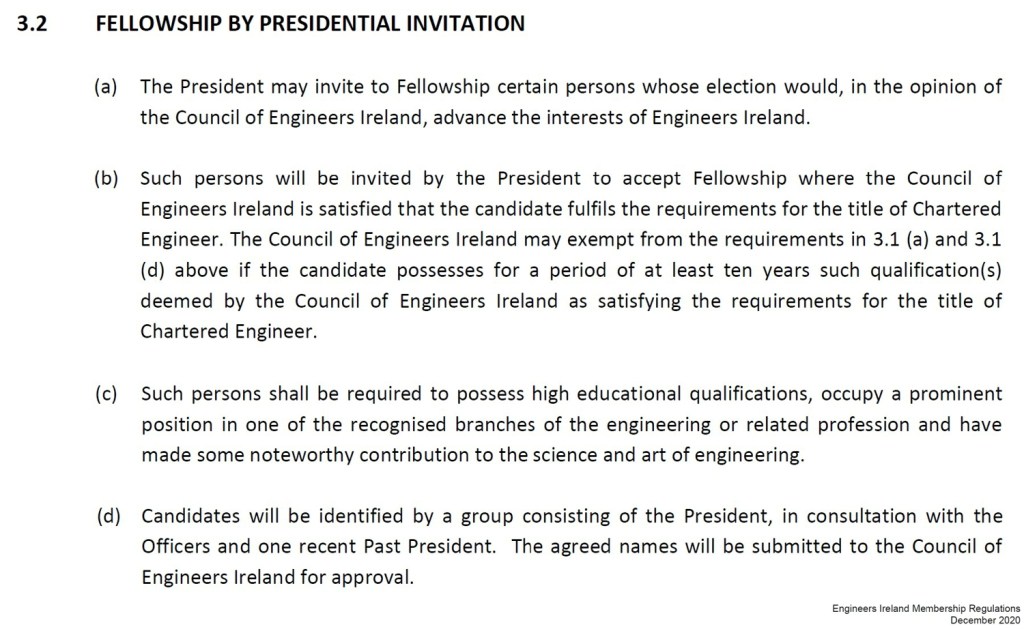
On a cursory reading of this section 3.2, of the Membership Regulations(2020) and in particular Clause 3.2 (b) we highlight that where “Council of Engineers Ireland is satisfied that the candidate fulfils the requirements for the title of Chartered Engineer”, they {members of Council} may “exempt from the requirements in 3.1 (a)…” for which the candidate has “been a Chartered Engineer of Engineers Ireland…”. On closer scrutiny, one realises that according to Clause 3.2 (d), only “the agreed names will be submitted to Council of Engineers Ireland for approval.”
At what point, therefore, in the process, do members of Council satisfy themselves of their implied discretion if only candidate names are submitted?
Examples of governance irregularities that occurred over the last decade, were, we understand, brought to the attention of Engineers Ireland in 2020, and in particular to the Chairman of the Membership and Qualification Board in late 2020. In that communication the Chairman was asked regarding a specific case to “provide details of the process the Membership and Qualification Board undertook outlining what deviations were taken in order to satisfy Membership Regulations Clause 3.2(b) for non-members of Engineers Ireland who were awarded Fellow of Engineers Ireland by way of presidential Invitation”.
We have seen the reply issued by the Chairman of the Membership and Qualification Board in mid-February 2021, some thirteen weeks later, which included the following response:
“The Presidential Invitations to Fellow are normally presented to the Spring meeting of the Council. Prior to the Council meeting there is a call for suggestions for nominations and these are reviewed by the President and the qualifications of the potential nominees are researched by the Secretariat to ensure compliance with the Membership Regulations. Once a final list is available it is presented to the Membership and Qualifications Board for review and discussion.
I am not at liberty to discuss the assessment criteria for any individual member or potential member the deliberations of the MQB on specific cases must remain private. In general, in assessing applicants for membership through non-standard routes (i.e., all cases where the applicant does not possess a Level 9 Engineering Degree accredited by Engineers Ireland) the MQB follows a process that include:
- Verification of documentation by the secretariat.
- Detailed consideration of the application assigned to members of the Board in the discipline of the applicant.
- Discussion of the finding by the Board.
- Interview of the applicant if deemed necessary.
- Decision.”
One might be forgiven for accepting the bona fides of this response on behalf of Engineers Ireland by the Chairman of the Membership and Qualification Board until it appeared to be contrary to the Chairman’s input to the discussion at a subsequent Council meeting only three months later where he said:
“that the MQB [Membership and Qualification Board, is] happy to have a role in reviewing this and considering the qualifications of those put forward for Presidential Invitation to Fellow”.
We have already demonstrated the hollowness Engineers Ireland places in living by its own values, in previous articles, including; Walking the Talk and Environment, Ethics and Engineers. Most definitions of ‘Trust’ (one of Engineers Ireland core values), ascribe a “firm belief in the reliability, truth, or ability of someone or something”. Integrity[8],[9] is not an optional extra for Chartered Engineers.
Since 2014, seven Presidents[10] of Engineers Ireland have been prior recipients of the Presidential Invitation to Fellow. Based on this frequency, it is highly unlikely there will be any change to this pattern in the presidency (2022-2023).
True to form, it was announced at the Annual General Meeting 2023 by the outgoing president that the Junior Vice President, was none other than the Chair of the Finance Committee (2018-2022), Chair of the “newly-merged Finance, Audit and Risk Committee” (2022- ), and recipient of the Presidential Invitation to Fellow during the presidency (2020-2021). Incidentally, that President (2020-2021) was also the recipient of the Presidential Invitation to Fellow during the presidency (2016-2017).
That will make it eight! The updated Figure maps some of the relationships and linkages, which demonstrate a complete lack of governance oversight and in some instances the practices cannot be considered as coincidence. It is reasonable to infer from this type of behaviour that Engineers Ireland lacks impartiality.
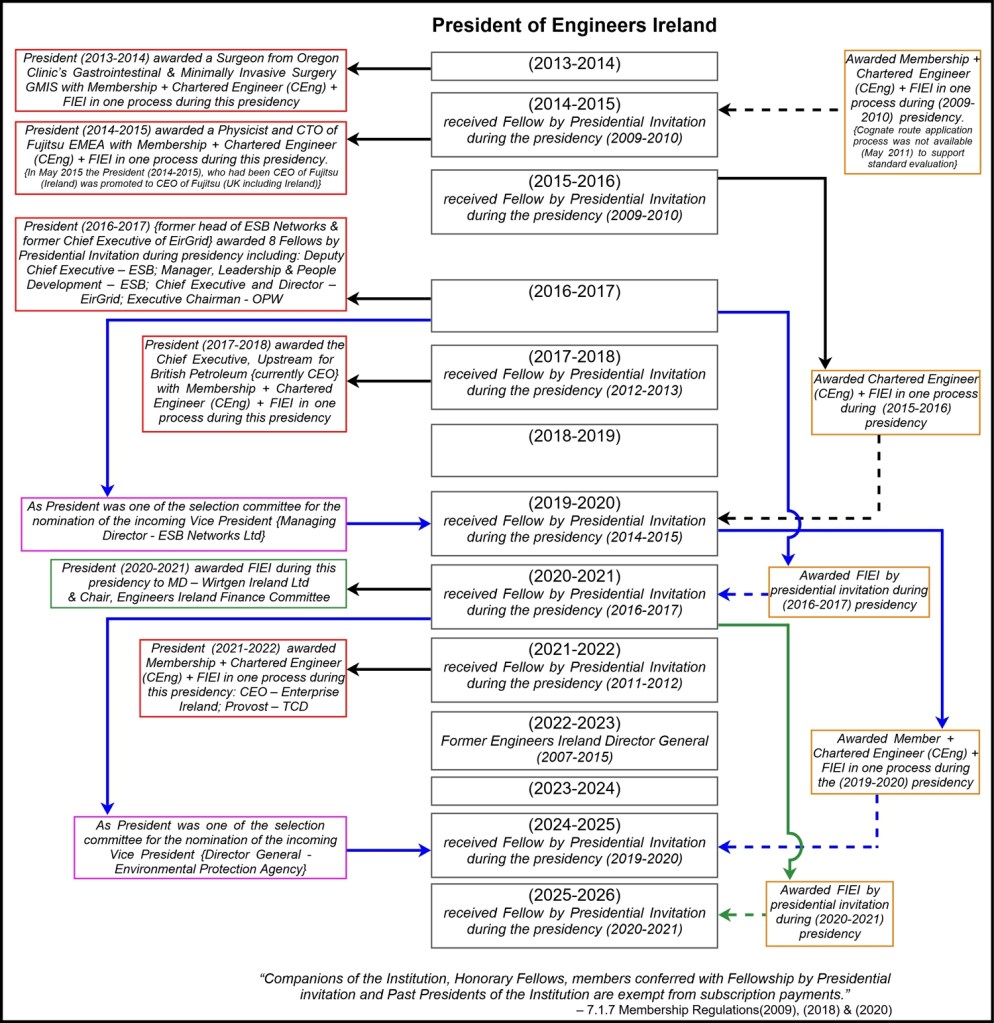
Coincidence or Contrived?
There are a number of critical questions regarding this privileged discretion the President of Engineers Ireland chooses to use or abuse:
- With the latitude provided for in Clause 3.2(a) of the Membership Regulations(2020) “the President may invite to Fellowship certain persons whose election would, in the opinion of the Council of Engineers Ireland, advance the interests of Engineers Ireland” why is it the case that Chartered Engineers (Members) who have also given years of voluntary service to the development and promotion of the Institution seldom feature on the list of invitees to Fellowship?
- By admission we now know that the Membership and Qualification Board has not been involved in “considering the qualifications of those put forward for Presidential Invitation to Fellow”, and by extension the Board of Examiners, responsible for the supervision and quality assurance of the Professional Review procedures leading to the award of the Registered Professional Titles failed to report on this matter. Has the Board of Examiners not failed in its duty to protect the integrity of the Registered Professional Titles?
- While Clause 3.2(b) states that only such candidates put forward by the President for Presidential Invitation to Fellow “where the Council of Engineers Ireland is satisfied that the candidate fulfils the requirements for the title of Chartered Engineer”, Clause 3.2(d) facilitates only “the agreed names will be submitted to the Council of Engineers Ireland for approval”. How, therefore, have members of Council fulfilled their function in accordance with Section 3, subsection (c) of The Institution of Civil Engineers of Ireland (Charter Amendment) Act 1969?[11]
- A pattern has emerged, as demonstrated in the Figure above, that when the very governance processes available to prevent unethical behaviours are ignored, what could only be described as cronyism emerges. As a consequence, have those who participated in such conduct not risked bringing Engineers Ireland into disrepute or prejudiced Engineers Ireland? {Refer to Clause 3.1 Code of Ethics(2018)} Of course, Members should also be aware that conduct which may bring Engineers Ireland into disrepute or which may prejudice Engineers Ireland has also been omitted from the Code of Ethics(2023). Another coincidence perhaps?
- Is it not demoralising for Members, who not only may have given years of voluntary service to the Institution, but have valued the recognition of their peers by applying and undertaking the formal process route to the Registered Title of Chartered Engineer (CEng), and subsequently may have submitted their application for the title of Fellow of Engineers Ireland (FIEI), all the while maintaining their annual CPD records and paying their application(s) and membership fees in the knowledge that: 1) “Companions of Engineers Ireland, Honorary Fellows, members conferred with Fellowship by Presidential invitation and Past Presidents of Engineers Ireland are exempt from subscription payments”;[12] 2) are not required to submit any record of CPD; 3) are not required to sign annually the declaration to abide by the Code of Ethics, or Bye-laws and 4) have their membership and Registered Title into perpetuity regardless?
- In the context of Clause 3.2(a) are Members not entitled to an update on how those recipients of the Presidential Invitation to Fellow have advanced “the interests of Engineers Ireland”?
[1] Clause 3.2(a) Membership Regulations(2020)
[2] Clause 3.1(a) Membership Regulations(2020)
[3] Clause 3.3(a) Membership Regulations(2020)
[4] 1) Regulations for the Registered Professional Title | Chartered Engineer; March 2015; 2) Guidance Notes for Application Preparation | Chartered Engineer; March 2014
[5] Engineers Ireland Annual Report 2011; page 30
[6] Engineers Ireland Annual Report 2011; page 30
[7] The Membership Regulations(2020) incorporates a 2018 revision to Section 3 ‘Fellowship of Engineers Ireland‘ compared to what was in Membership Regulations(2009): 3.2(a) text changed. 3.2(b) is now 3.2(c). 3.2(c) is now 3.2(b) with additional text. 3.2(d) unchanged
[8] Clause 1.1 Code of Ethics(2018): “Members shall behave with integrity and objectivity in their relationships with Colleagues, clients, employers, employees and with society in general.”
[9] Clause 17.1 Bye-laws(2012): “Members shall act in accordance with proper professional standards and shall order their conduct in such a manner as to uphold the dignity, standing and reputation of Engineers Ireland. Members shall observe and comply with all regulations and with the Code of Ethics….”
[10] The name of the President of Engineers Ireland is published in the Annual Report: Annual Report 2021; Annual Report 2020; Annual Report 2019; Annual Report 2018; Annual Report 2017; Annual Report 2016; Annual Report 2015; Annual Report 2014; Annual Report 2013
[11] 3.—”The Charter shall henceforth be construed as providing that the purposes of the Institution shall include:— (c) ensuring that the description “Chartered Engineer” or the use of initials or letters having a similar significance is confined to a category of engineers who have satisfied the Council of their professional competence and experience, or who are authorised so to describe themselves by a professional body recognised by the Council in that behalf,”
[12] Clause 7.1.7, Membership Regulations(2020)





 Conscientious Observers