On 20th April 2023 we witnessed a cynical launch of the Chartered Environmentalist Professional Title by Engineers Ireland literally weeks after its revision to the Code of Ethics(2023) manifested the Engineers Ireland U-turn on members’ ethical obligations to tackle climate change and biodiversity loss. To put this in context, the day following the launch, 21st April, “Ireland will have used all the ecological resources that the Earth can regenerate this year” – recognised as ‘Overshoot Day’. For the remaining 254 days of this year, we will be ‘over-consuming’. But then again any reference to ‘sustainable’ has been removed from the lexicon in the revised Code of Ethics(2023) by Engineers Ireland.
That is not the only omission in the Code of Ethics(2023). Members should also be aware that the clause which dealt with conduct which may bring Engineers Ireland into disrepute, or which may prejudice Engineers Ireland has also been omitted. {Refer to Clause 3.1 Code of Ethics(2018)}[1]
The following example from 2011, which we understand was brought to the attention of Engineers Ireland in early 2020 as a governance irregularity perhaps provided sufficient motivation for this latter omission from the Code of Ethics(2023).
How does a non-member of Engineers Ireland, who has not undertaken any of the recognised Engineers Ireland accredited graduate or post-graduate engineering programmes, become a Member, a Chartered Engineer and a Fellow, all within a matter of days? The answer is by the President exercising the privilege of Presidential Invitation to Fellow. This happened before the Membership Application Form for those with cognate qualifications had been published. Yet again, integrity appears meaningless in Engineers Ireland’s pursuit of membership growth.
Governance by way of regulations regarding the requirements for the title of Chartered Engineer and the Presidential Invitation to Fellow is provided for in the Membership Regulations(2020).[2] In order to become a Fellow of Engineers Ireland there is a fundamental requirement to be a Chartered Engineer; “Considered to be the gold standard of the profession, the professional title of Chartered Engineer was established in Ireland over 50 years ago.” [3]
The process to Registered Titles in Engineers Ireland is well defined. In particular, the award of Chartered Engineer requires a sufficient level of knowledge, experience and responsibility in key competencies, along with a demonstration of the necessary awareness of the Bye-laws and Code of Ethics.
Engineers Ireland, according to its website, “is a qualification-based membership organisation that needs to confirm you completed your qualification before you can be considered for full membership (“MIEI” stands for Member of Institution of Engineers Ireland) by our Membership Qualification Board (MQB).” The following are some of the bodies established by the Executive Board engaged in these duties:
“On behalf of Council, the Membership and Qualification Board is responsible for the development, establishment and implementation of the policies, regulations and procedures required for the implementation of the Council’s statutory functions and obligations in respect of the Register and all other matters related to the membership grades and professional titles of Engineers Ireland.” [4]
“On behalf of Council, the Board [of Examiners] is responsible for the supervision and quality assurance of the Professional Review procedures leading to the award of the Registered Professional Titles of Engineers Ireland to qualified candidates.” [5]
The period 2009-2011 saw substantial change in approach by Engineers Ireland to broadening its membership base. The President (2010-2011) in his report[6] on behalf of Council provided the following summary:
“In September 2009, the Council decided to separate membership of Engineers Ireland from titles and in the process opened membership to Level 7 accredited engineering graduates and to graduates from cognate undergraduate courses in the physical sciences, computing and mathematics whose careers in practical terms position them as engineers.”
“During my year, detailed proposals were developed setting out the pathways by which graduates from different educational back grounds can in due course become members of Engineers Ireland (MIEI). These proposals were approved by Council in November 2010……. Much of the work and communications needed to map out the pathways by which members with differing educational back grounds could become a Chartered Engineer was progressed. Draft proposals were submitted to Council in April 2011 and they will be considered further at a future Council meeting.”
Indeed, there was work still to be done, regarding the process and stages of title recognition for those advancing membership from the additional educational back grounds according to the April 2011 Council Minutes of Meeting: “a Group, under the Chairmanship of an Officer or Past President, …. and to include the Chair of the MQB be established to consider the merits and implications of the second stage proposal and to report back to Executive and Council before the end of 2011” which “was unanimously adopted and Group established”.
Has Council been misled once again?
We have already highlighted such a pattern in “Engineers Ireland U-turn on ethical obligation to tackle climate change and biodiversity loss”. The Application Route For Graduates Of Cognate Qualifications (May2011) was published in May 2011. Nevertheless, following an email circulated to members of Council four days after the April 2011 Council meeting the highlighted text was inserted into the ‘official record’ of the Council meeting minutes that had already taken place.
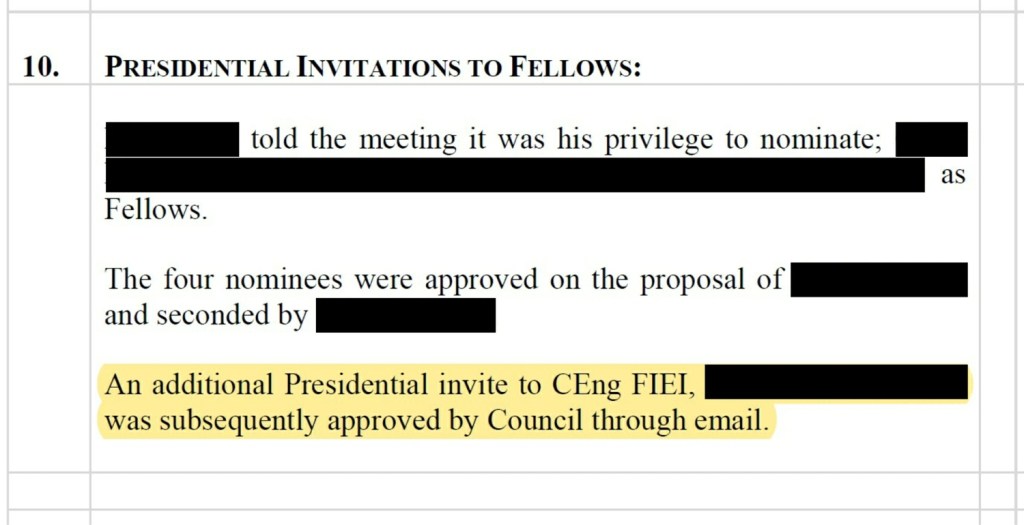
Notwithstanding the governance issues of recording an event that did not occur during the meeting in the official record of the meeting, even the inserted text is technically incorrect. The Presidential Invitation to Fellow is only available to Chartered Engineers (CEng). If the candidate is not already a Chartered Engineer, then the Registered Title has to accompany the privilege bestowed by the President.
The President (2010-2011) however, some weeks later was confident to report that;
“over the past year, the Board [of Examiners] has continued to ensure that adequate and consistent professional engineering standards are maintained”.[7]
As recently as the January of 2011 Council meeting the then Registrar (2010-2022) was informative on those that do not have any accredited or non-accredited engineering or cognate qualification, in a presentation entitled ‘Consultation Paper on the Revised Routes to Professional Titles for Engineers’:
“If a candidate feels that he/she has significantly contributed to the profession over a long period then it is not unreasonable to expect them to have at least joined as MIEI and to hold membership for a period of not less than 10 years. During this period an assessment of the candidate can be realistically and accurately formed.”
Again, the Registrar (2010-2022) in the same presentation provided clarity on candidates presenting with ‘Cognate’ qualifications:
“A degree in a cognate discipline will need to be assessed to fully understand the match of the course outcomes against those of an equivalent engineering qualification. Gaps in outcomes identified as part of this process will have to be addressed by undertaking additional education modules.”
Appended to this item of particular importance are Notes 3 and 5:
“MIEI membership must be kept current throughout and must include 4 consecutive years at MIEI before application for a title.”
“An educational institution could accept a level 8 cognate degree holder onto an accredited engineering level 9 programme (i.e. the acceptance of students into an accredited engineering course must be within the Engineers Ireland accreditation framework).”
The Membership and Qualification Board perhaps sought guidance from the yet to be published Application Route For Graduates Of Cognate Qualifications (May2011) in the example brought to its attention in 2020:
According to the cognate application route section 8.1, the applicant must hold a level 8 qualification within the specific cognate list. While ‘Environmental Science’ was included on this list, the Membership and Qualification Board was asked what definition it used to assess the relevance of course content or the proportion of the overall level 8 course, concentrated towards, in this instance Environmental Science? In this particular example, according to University College Dublin the Bachelor of Agricultural Science (BAgrSc) course content at that time, focused specifically on the environmental impacts of agriculture during third and fourth year. Surely, this is a substantially different interpretation of the level 8 qualification being a degree in ‘Environmental Science’ as specified in the cognate list?
The cognate application route, section 8.5 puts the responsibility firmly with the supporters of the application: “This form confirms in the supporters considered view that you (the applicant) are a candidate who merits consideration for admission to MIEI (membership of Engineers Ireland).”
For successful candidates, following the assessment conducted by the Membership and Qualification Board, the cognate application route, section 8.7 specifically addresses their current status: “On election to membership candidates will be advised that they have NOT been assessed for a route to any of the Professional Titles…..”
Membership Expansion Initiatives – At What Cost?
It wasn’t until reading an article published on 26th October 2011 by the President (2011-2012) of Engineers Ireland, titled “Calling all Environmental Scientists” in ’The diary of the President of Engineers Ireland for 2011-2012‘, that the motivation behind this example became obvious – another potential revenue opportunity.
Has the manner in which this example, facilitated by the leadership in Engineers Ireland, not brought into disrepute its own governance in awarding the Registered Title of Chartered Engineer?
[1] “Members shall not engage in conduct which is dishonest or illegal or which may bring Engineers Ireland or the profession into disrepute or which may prejudice Engineers Ireland or the profession.” Clause 3.1 Code of Ethics(2018)
[2] While the Membership Regulations(2020) incorporates a 2018 revision to Section 3 “Fellowship of Engineers Ireland” that would have been in Membership Regulations(2009) the appropriate reference document for the example provided, there is no change to Section 2 “Registered Professional Titles”.
[3] Pathway to Chartered Engineer Title 2020
[4] Engineers Ireland Annual Report 2011; page 30
[5] Engineers Ireland Annual Report 2011; page 30
[6] Engineers Ireland Annual Report 2010; page 6
[7] Engineers Ireland Annual Report 2010; page 32
Featured image courtesy of Alexey Y Petrov via shutterstock