

Founded in 1835 as the Civil Engineers Society of Ireland, in 1877 it received a Royal Charter after being renamed ‘The Institution of Civil Engineers of Ireland’. The Institution of Civil Engineers of Ireland (Charter Amendment) Act, 1969 established a new professional body, ‘The Institution of Engineers of Ireland’, as the sole body licensed to award the title ‘Chartered Engineer’ within the State. The first Director was appointed in 1970. The Institution was re-branded as ‘Engineers Ireland’ in 2005. The current Director General is only the ninth in the Institution’s history.
Social Responsibility
Just one century ago, in 1924 the former President of this Institution, P. F. Purcell emphasised, in his presidential address, the importance of Members publishing technical articles as well as the valuable lessons gained through experience to inform other engineers alike: “To a certain extent the prestige of an Institution like ours depends on its age, its Charters and its traditions, but the real test of its position must be found in the value of its contributions to our stock of knowledge. In other words, we must look to its published Transactions[1] to secure an impartial view of its position. From a careful review of the Transactions, it will be seen that, while the importance of the communications varies from one year to another, the 46 volumes already issued constitute a sufficient testimony to the value of the contributions of our members.”[2]
In his Inaugural Address to Members, the former President of this Institution, W. H. Mills, in 1885 recognised “the records of past experience, and the knowledge gained from scientific research, give us immense advantage over our predecessors, who had few practical examples to refer to…. Still, with all this information before him, the engineer cannot relax the thorough consideration that is incumbent upon him, for, in assuming the duties of his profession, the engineer must fully understand that it is second to none in importance. The most important duty is where there is the greatest responsibility, and there is no greater responsibility than the care of human life.”[3]
In the 1971 Presidential Address, former President of this Institution, J. H. Harbison remarked that “in Ireland many of our attitudes are borrowed from elsewhere. Being as small as we are, located between two dominant civilisations of the Old and New World, it would be surprising were we not strongly influenced. But in this matter of attitudes to Science and Technology we should be wary of passively being influenced without making a serious attempt to create in our society an awareness and serious understanding that makes Science and Technology a benign thing not necessarily to be feared or irrationally controlled.”[4] In addition, he said, “Education of engineers in a social awareness of the effects of their work and its validity in providing for the ‘convenience of man’ is vital. This must go beyond the intrinsic natural circumstances of any problem to the broader human and terrestrial context within which the problem poses itself.”[4]
Just over fifty years later, in 2023, we would witness Engineers Ireland change course and abandon members social and environmental responsibilities by purposely omitting them from its Code of Ethics, even though the public priorities for science, engineering and technological innovation, as reported[5] by Engineers Ireland in 2020, placed the “fight against climate change” the second highest at 90%. Why does Engineers Ireland ignore feedback from the public in this instance?
Furthermore, over the past decade, there has been a worrying decline in Higher Education Authority (HEA) graduate engineers becoming Members of Engineers Ireland, with 52% of the membership growth in 2023 now attributed to ‘Global’ engineers from 72 countries according to Engineers Ireland Annual Report 2023.
Public Perception
The Council of Engineers Ireland recognised the definition of a professional engineer, adopted by the Conference of Engineering Societies of Western Europe and the United States of America in 1960 which is as follows:
“A professional engineer is competent by virtue of his fundamental education and training to apply the scientific method and outlook to the analysis and solution of engineering problems. He is able to assume personal responsibility for the development and application of engineering science and knowledge, notably in research, designing, construction, manufacturing, superintending, managing and in the education of the engineer. His work is predominantly intellectual and varied, and not of a routine mental or physical character. It requires the exercise of original thought and judgement, and the ability to supervise the technical and administrative work of others.”[6]
The first fundamental principle of this Institution’s ‘Standards of Professional Conduct’, which came into effect in 1971, stated that “every member of the Institution shall order his/her conduct so as to serve the public interest and uphold the honour and standing of the Institution and of the Engineering Profession.” This document was superseded by the introduction of the Code of Ethics, first approved by Council of the Institution on 22nd November 2003. Interestingly, the phrase “to serve the public interest” never did make it into any revision of the Code of Ethics.
Nevertheless, it wasn’t until 2018 when Engineers Ireland “commissioned Behaviour & Attitudes (market research company) to undertake a face-to-face poll with 1,000 members of the public” that we get an opportunity to gauge how the public perceive the professional engineer. The Institution has continued the practice most years since with the poll in the latest report conducted by “Ipsos B&A”. The perception of the public in some of these reports is of particular interest for the purposes of this article.
The current Director General of Engineers Ireland said that engineering “is critical to ensuring that our infrastructure, our economy, and our public services can support living standards and sustainable growth”,… it touches lives, transforms communities, and safeguards our future”[7] in the Foreword to its recent publication Engineering 2024 – A Barometer of the Profession in Ireland.
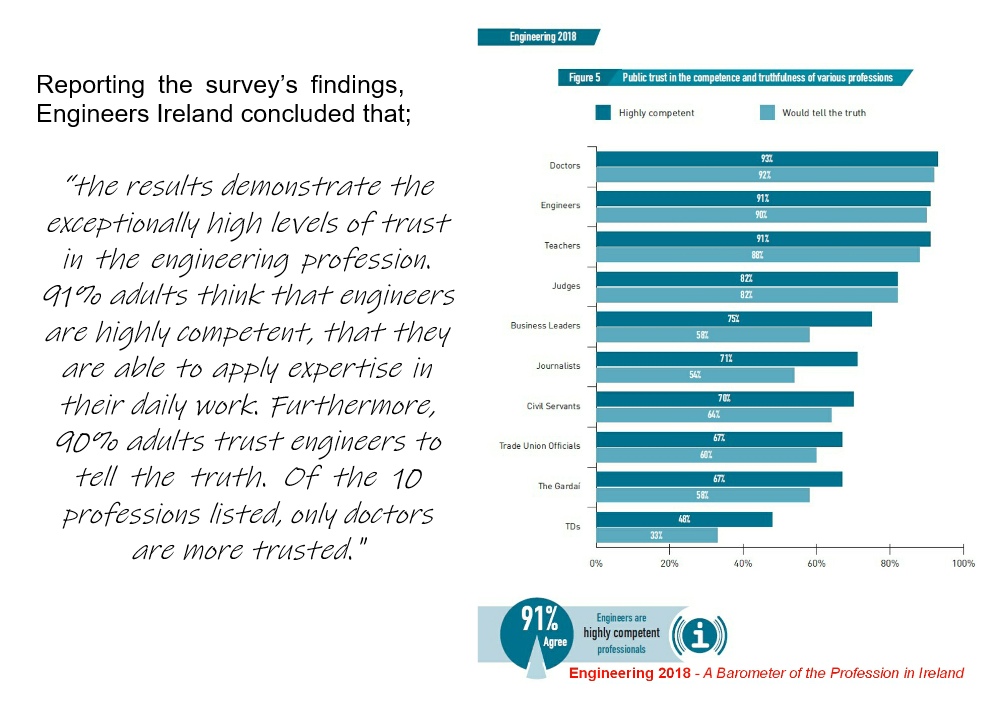
Reported in Engineering 2018 – A Barometer of the Profession in Ireland the “first question put to the public”, “sought to benchmark the levels of trust placed in engineers against trust in other professional groups. This built on research carried out by the Medical Council of Ireland’s ‘Survey of Public Attitudes to Doctor’s Professionalism’ whose methodology” Engineers Ireland “replicated”. The former Director General (2015-2022) in its Foreword maintained that “this report demonstrates the exceptionally high levels of trust in engineers, who are regarded as highly competent professionals.”
The feedback[8] sought from the public was in the context of the following:
- “Highly competent professionals need to be able to apply expertise in their daily work. Which of the following professions do you consider to be highly competent?”
- “Can you please tell me if you trust each of the professions listed to tell the truth or not?”
The survey results presented in the report are provided in Figure 1.
Reported in Engineering 2019 – A Barometer of the Profession in Ireland Engineers Ireland “sought to better understand public perceptions of risk of harm and the role of the various professions. In the first question of the poll (to avoid inducing bias)”, it asked, in the context of the respondents being “presented with a randomised list of 10 areas of work, based on the list of professions used in 2018”:
- “Some work can cause serious harm to the public if it isn’t done correctly. In which of the following areas of work is there a serious risk of harm?”
The survey results presented in the report are provided in Figure 2.

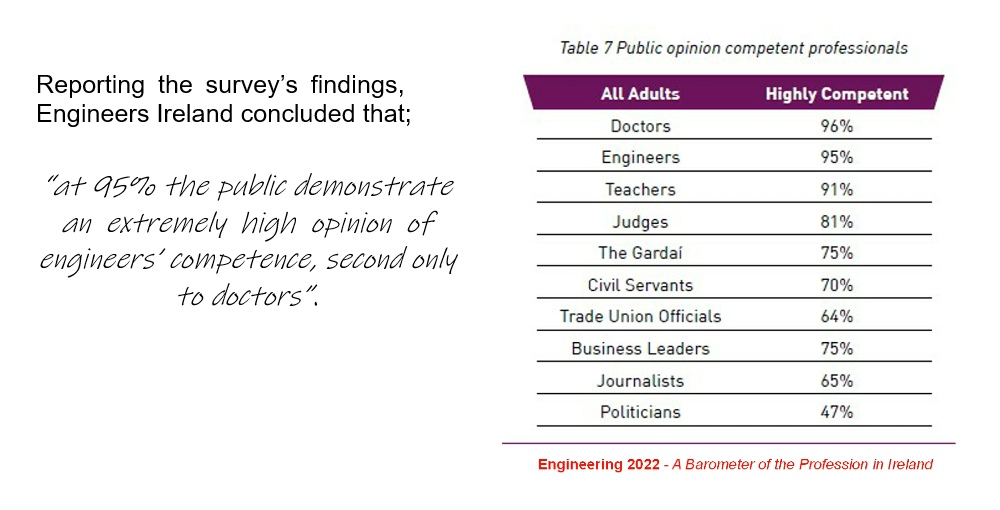
Reported in Engineering 2022 – A Barometer of the Profession in Ireland the survey presented the following statement to respondents from the public; “Highly competent professionals need to be able to apply expertise in their daily work”, and asked the question “Which of the following professions do you consider to be highly competent?” Engineers Ireland did not confirm if the professions were “based on the list of professions used in 2018” as it had done in the 2019 report. The survey results presented in the report are provided in Figure 3.
In its most recent publication Engineering 2024 – A Barometer of the Profession in Ireland the question prefaced by a statement put to the public was “Highly competent professionals need to be able to apply expertise in their daily work. Which of the following professions do you consider to be highly competent?” The survey results presented in the report are provided in Figure 4.

Finally, with the summit reached, is that what the “face-to-face poll with 1,000 members of the public” was all about?
In this same report, “when the public was asked to agree or disagree with the statement ‘engineers can be trusted to act with integrity in the course of their work’, 81% agreed or strongly agreed that engineers act with integrity.” In the context of this article, it will be interesting to see if this metric is reported again in the 2025 barometer report, following our recent publication Public Interest no longer served – Engineers Ireland removes right to Appeal.
Significance of “The Key Men”
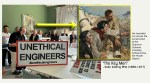
An unscheduled meeting with representatives from the Defective Concrete Block home-owners was facilitated at Engineers Ireland headquarters, under what appears to be the watchful eye of “The Key Men” in the iconic Keating painting. It would be tragic, if the Institution were to default to its Art of Equivocation in addressing the concerns of this representative group.
Former President of this Institution, J. H. Harbison remarked “Engineers are aware of having a material and significant role in community life today…..Only 40 years ago the Shannon hydro-electric Scheme was a nine days wonder – considered by many citizens of the time a fantasy of megalomania.”[4] Appropriate then that “the work of Seán Keating RHA (1889-1977), spanned an exciting era of Ireland’s history when the nation emerged from centuries of repression” is recognised in the home of the Engineering Profession. “Keating was awarded perhaps one of the most important commissions when he was allowed to record on canvas the construction of the Shannon Scheme including Ardnacrusha, the ESB Power Station on the Shannon.”[9]
Furthermore, “Keating became close to a number of German and Irish engineers working on [the] scheme; he stayed in one of the camps while undertaking the series of paintings, and some of his titles reflect their language and his respect for their profession…. Construction involved the removal of 7.6 million cubic metres of earth and 1.2 million cubic metres of rock and the use of a quarter of a million cubic metres of concrete.”[10] Finally, the sluice gates at Parteen Weir were opened on 22nd July 1929. “By 1936/7 the hydro-electric power station at Ardnacrusha supplied eighty-seven per cent of system demand in Ireland.”[10] We are reminded that “Keating’s paintings are not just drawings, sketches and paintings of a major project. They capture the spirit, ingenuity and perseverance of those responsible for making a major contribution to the transformation of our society…”[9]
Reality
We are told, that at the time, Keating was “preoccupied with the heroic role of ‘The Key Men’ through whom the objectives of the state are to be realised. Through their direction, guidance and control of technology, labour and raw materials, the landscape is gradually reshaped to fulfil the social objectives of the new state.”[10]
Noteworthy, that the President (2021-2022) a woman, presented a framed print of this Keating painting “The Key Men” to another woman President (2019-2020) as a memento of her year in office. While the irony of this gesture may have not registered with many, it is however, consistent with the hypocrisy by this Institution towards women Members being employees of Engineers Ireland.
Purcell, Mills and Harbison were cognisant of the responsibility and role Engineers play in Society. The Institution reflected this in the first fundamental principle of its Standards of Professional Conduct “to serve the public interest”. Along with “there is no greater responsibility than the care of human life” such cornerstones established an ethos, practiced and embodied by so many Members and former Members of this Institution. It is difficult, therefore, for them to imagine:
- That under the watchful eye of this iconic Keating painting and the significance it has among the professional engineering community, Defective Concrete Block home-owners – members of the public – had to travel to Engineers Ireland headquarters to convey their collective experience of unethical practices by some Chartered Engineers, Members of this Institution, that are engaged in the State’s redress process.
- The humiliation for this Institution with the realisation of “face-to-face” public feedback from the lived experience on full display.
- The manner in which Engineers Ireland has systematically dismantled the Institution’s ethos, purged accountability from its Code of Ethics, and adjudicates complaints of Professional misconduct, a process devoid of the principles of natural justice, ultimately excluding Members and the public from their right to appeal.
If apathy is to become the Chartered Engineers’ intergenerational legacy, then;
“Each to his own, you might say, and everyone gains. Or do they? Who now is responsible for what? The new dispersed, subcontracted, almost invisible organisation is a wonderful excuse to pass the buck if anyone complains.”[11]
[1] “The Transactions of a professional body such as this are usually, to a large extent, devoted to a record of works executed, and from the experience thus gained valuable lessons may be derived.” [2]
[2] Extract from the Address of the President; Transactions of the Institution of Civil Engineers of Ireland; Volume 49, 1924
[3] Extract from the Address of the President; Transactions of the Institution of Civil Engineers of Ireland; Volume 15, 1885
[4] Extract from the Address of the President; Transactions of the Institution of Civil Engineers of Ireland; Volume 96, 1971
[5] Engineering 2020 – A Barometer of the Profession in Ireland; Engineers Ireland; Table 8, Pg.20. The priority was highest among ‘Young family’ (93%) and ‘Under 25yo’ (92%)
[6] Regulations and guidelines for Chartered Membership and for the Professional Interview; Engineers Ireland (Revised 1978)
[7] Engineering 2024 – A Barometer of the Profession in Ireland; Engineers Ireland
[8] Engineering 2018 – A Barometer of the Profession in Ireland; Engineers Ireland
[9] https://www.universityofgalway.ie/about-us/news-and-events/news-archive/2001/october2001/major-exhibition-of-sean-keatings-paintings-comes-to-galway-1.html
[10] https://www.historyireland.com/keating-siemens-the-shannon-scheme/
[11] Handy, C., “The Elephant and the Flea” (2001)



 Conscientious Observers