

– covert actions to distance itself further from Industry Regulation
“Even trust”, according to Judt[1], “the faith we have in our fellow citizens, corresponds negatively with differences in income: between 1983 and 2001, mistrustfulness increased markedly in the US and UK and Ireland – three countries in which the dogma of unregulated individual self-interest was most assiduously applied to public policy. In no other country was a comparable increase in mutual mistrust to be found.” A quarter of a century later, has much changed?
On Wednesday 4th September 2024 we were reminded of the horrific events of 14th June 2017 that led to the death of 72 people, perished in the Grenfell Tower fire, following the publication of the Phase 2 Report[2].
- “There was a complete failure on the part of the [Local Authority Building Control] LABC over a number of years to take basic steps to ensure that the certificates it issued in respect of them were technically accurate.”[2]
- “Safety of people in the built environment depends principally on a combination of three primary elements, good design, the choice of suitable materials and sound methods of construction, each of which depends in turn in a large measure on a fourth, the skill, knowledge and experience of those engaged in the construction industry.”[2]
- “The United Kingdom Assessment Service (UKAS), the organisation charged with accrediting them, failed to apply proper standards of monitoring and supervision.”[2]
- “Conformity assessment bodies provide a commercial service combined with an element of regulation, but the two functions do not sit easily together.”[2]
“The inquiry said that during the refit of the building there was a failure to establish who was responsible for safety standards – resulting in an “unedifying ‘merry-go-round of buck-passing’” [3]
It goes without saying, Chartered Engineers have been integral to the advancements made across all facets of society; Biomedical, Electronic, Computing, Infrastructure, etc, to name but a few. However, we shouldn’t rely on tragic events to act as a reminder of the trust Society places in us to perform our work ethically and with integrity. When there is evidence that this is not the case, accountability matters.
We have already witnessed the ambiguity of accountability Engineers Ireland introduced into the recent revision of the Code of Ethics(2023). However, on the matter of accountability, its revision saw Engineers Ireland create a separate document Disciplinary Procedures for Breaches of the Code of Ethics. What will be revealed in this review of that document, should be of concern, not only to the membership of Engineers Ireland, but all of Society.
Chartered Engineers and Building Profession
The Registered Title ‘Chartered Engineer’ is the only engineering title that has statutory[4] protection, granted to Engineers Ireland, formally called The Institution of Engineers of Ireland. The Institution has the responsibility, as the registration body, for setting the criteria to obtain the Registered Title of Chartered Engineer and to maintain appropriate standards.
The continuance of the privileged autonomy Engineers Ireland enjoys is contingent on maintaining the confidence of the government and the public in its governance arrangements. For example, a Chartered Engineer’s responsibilities in the Building Profession alone, is significant:
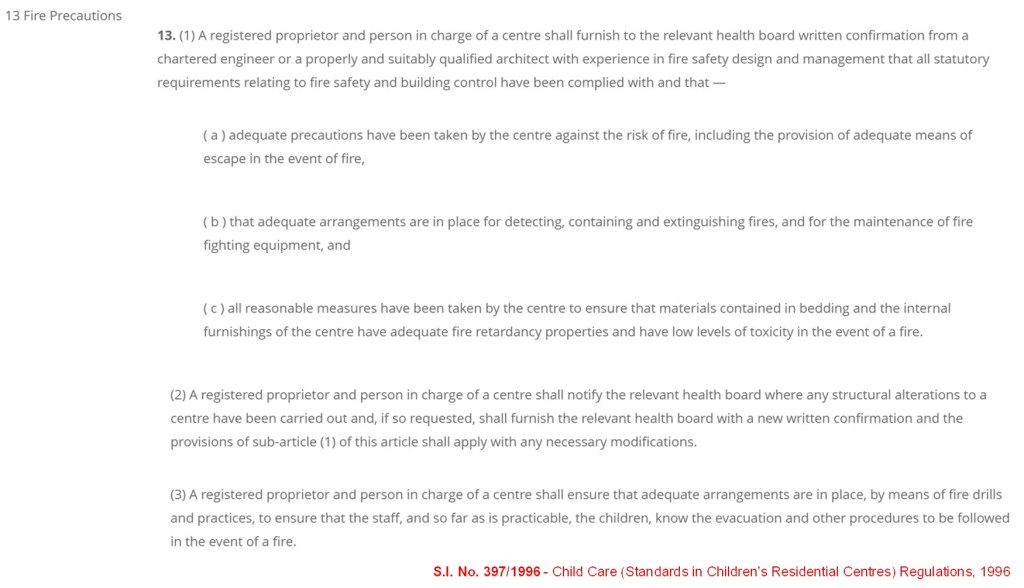
- Pursuant to Part VIII of The Child Care Act 1991, Standards in Children’s Residential Centres Regulations, Statutory Instrument SI No. 397 of 1996[5], requires “written confirmation from a chartered engineer or a properly and suitably qualified architect with experience in fire safety design and management that all statutory requirements relating to fire safety and building control have been complied with”. Figure 1
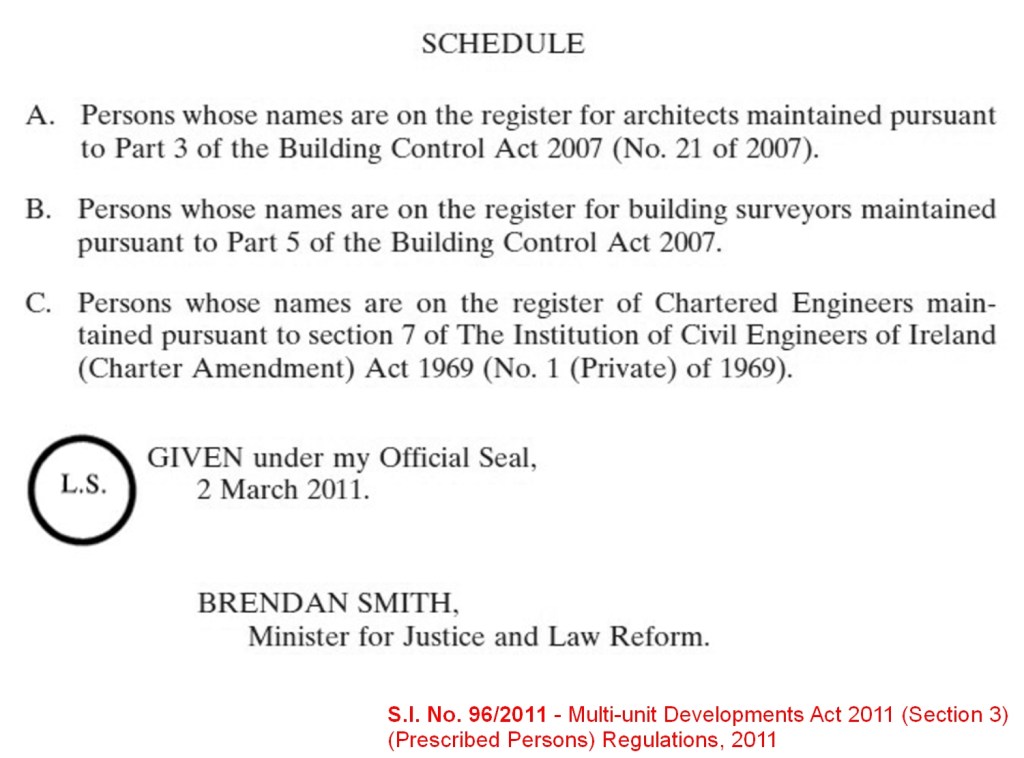
- The Multi-Unit Developments Act 2011, Statutory Instrument SI No. 96 of 2011[6], Section 3, places Chartered Engineers in a privileged position alongside ‘Building Surveyors’ and ‘Architects’ as Prescribed Persons. “C. Persons whose names are on the register of Chartered Engineers maintained pursuant to section 7 of The Institution of Civil Engineers of Ireland (Charter Amendment) Act 1969 (No. 1 (Private) of 1969).” Figure 2
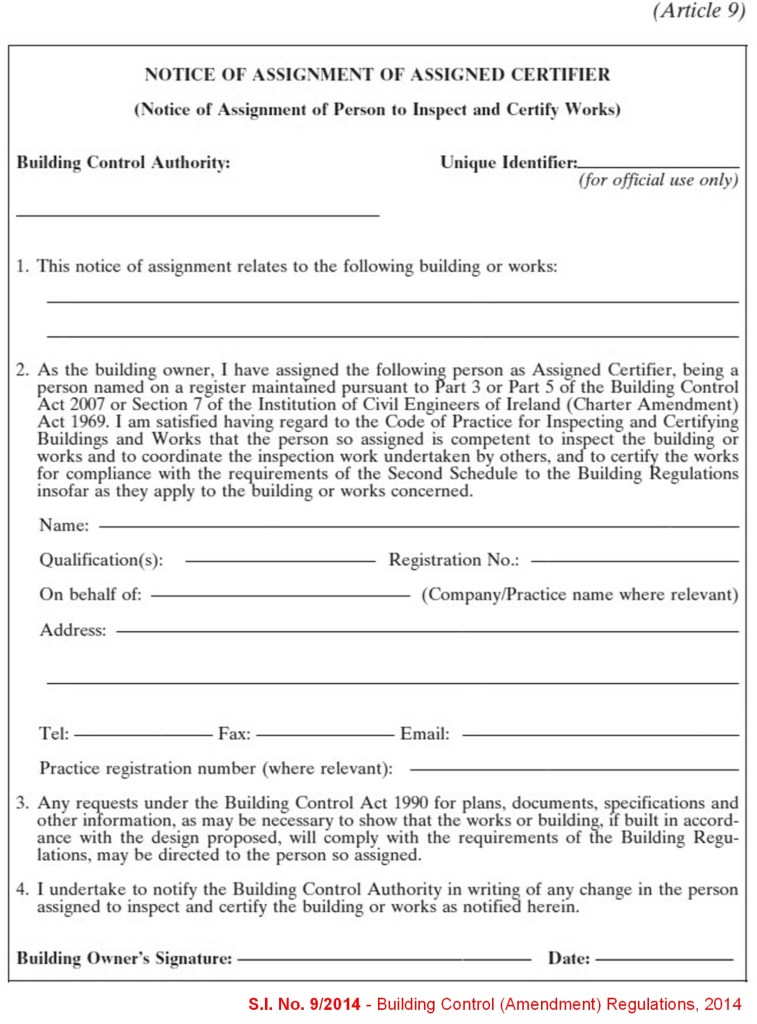
- Under the Building Control (Amendment) Regulations, Statutory Instrument SI No. 9 of 2014[7], Chartered Engineers may be appointed to provide a Design Certificate certifying compliance (Design) and as ‘Assigned Certifiers’ to inspect and certify works. Figure 3
Local Authorities
In 2021 a matter of concern was raised with Engineers Ireland regarding Local Authorities who appeared to be employing non-engineering qualified persons in engineering roles, clearly in breach of the qualification requirements for Engineering Services in Local Authorities[8].
The qualification requirements of candidates for the role of Assistant Engineer, Executive Engineer, Senior Executive Engineer, or Senior Engineer “shall hold an honours degree (level 8 in the National Framework of Qualifications) in Engineering” according to the Department of Housing, Planning, Community & Local Government, as it was referred to at that time.
In correspondence later seen from Engineers Ireland, such positions requiring the Level 8 NFQ are “intended to be the Chartered Engineer professional title”. Members of the West Region of Engineers Ireland, sought clarification if the only NFQ level 8 engineering courses, were those accredited by Engineers Ireland, since there were instances of the roles of both Assistant Engineer and Executive Engineer at Local Authorities, having been filled, over the past 15 years, where the Level 8 qualification in Engineering criteria would not appear to have been met. At the time of this publication, it is unclear if any action has been taken by Engineers Ireland to investigate this matter, or indeed if it has been brought to the attention of the Department of Housing, Local Government and Heritage.
Perhaps the seriousness of this matter has yet to register with Engineers Ireland? The responsibilities conveyed to Chartered Engineers via the various Regulations and Statutory Instruments, may have been undertaken by persons acting in Local Authority positions with statutory prescribed qualifications, who neither met the mandatory engineering qualifications nor had the “intended” registered professional title Chartered Engineer.
Building Control Bill
The Building Control Bill 2005[9], the legislative precursor to the introduction of the Building Control Act 2007 (Revised 2022), set out to provide registration of title of certain Building Professions, such “that the use of titles of ‘Architect’, ‘Quantity Surveyor’ and ‘Building Surveyor’ will be confined to persons with recognised qualifications/ training/ experience, whose names are entered on a statutory register”.
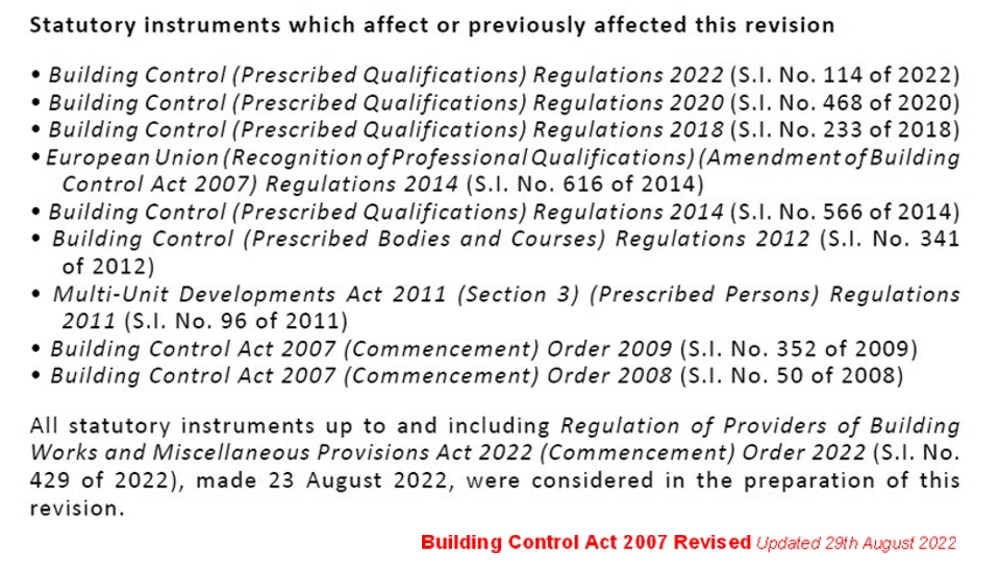
In addition, the Building Control Bill 2005[9] made provision for the strengthening of enforcement powers of Local Building Control Authorities, and the legal transposition of relevant parts of EU Mutual Recognition of Professional Qualifications Directive[10]. The Building Control Act 2007 (Revised 2022) regulates the use of the protected titles ‘Architect’, ‘Quantity Surveyor’ and ‘Building Surveyor’ to those registered under the Act[11]. It is an offence to use such titles unless registered to do so. The Statutory Instruments which affect the Building Control Act 2007 (Revised 2022) are listed in the Figure 4. Engineers Ireland as the registration body for Chartered Engineers whose names are entered on a statutory register, as Prescribed Persons, has a duty to ensure that its governance structures are consistent and aligned with the obligations for the other registration bodies of Prescribed Persons.
Engineers Ireland avoided inclusion in the Building Control Act 2007 (Revised 2022) probably making the case that it already had established processes in place:
- As we mentioned previously, the Registered Title ‘Chartered Engineer’ has statutory[12] protection in Ireland.
- Its statutory responsibility to regulate the engineering profession in Ireland is provided for in Statutory Instrument SI No. 135 of 1996.
- The Institution’s Standards of Professional Conduct, which came into effect in 1971 and last amended in 1993 had now been superseded by the introduction of the Code of Ethics, approved by Council of the Institution on 22nd November 2003. The Code of Ethics was subsequently revised by Council on 21st November 2009. It had already set out the make-up of the Ethics and Disciplinary Board, and the establishment of an Appeals Board, the membership of which would be review by Council every three years. The Code of Ethics(2018), approved by Council on 2nd December 2017, is predominantly referred to in this article, because it retains the relevant clauses from previous revisions.
While at the time, this case may have been well founded, the question remains, if over the years, that defence is still valid? The regressive revision to the Code of Ethics(2023) undertaken by Engineers Ireland was addressed in our previous articles; Environment, Ethics and Engineers and Engineers Ireland U-turn on members’ ethical obligations to tackle climate change and biodiversity loss. It is necessary to turn our attention to Section 4 in Code of Ethics(2018) which Engineers Ireland removed and revised to a separate document[13], approved by Council in December 2022 and compare it to both the provisions in the Building Control Act 2007 (Revised 2022) for the other registration bodies for Prescribed Persons. We will also take the opportunity to establish if the direction taken by Engineers Ireland with regard to disciplinary procedures is also regressive when compared to Section 4 in Code of Ethics(2018).
Fitness to Practice
For the purposes of this article, we will limit our focus of comparison to only one of the other Prescribed Persons, the Architect. The obligations on the registration body are unequivocal in the Building Control Act 2007 (Revised 2022). Consider the following examples:
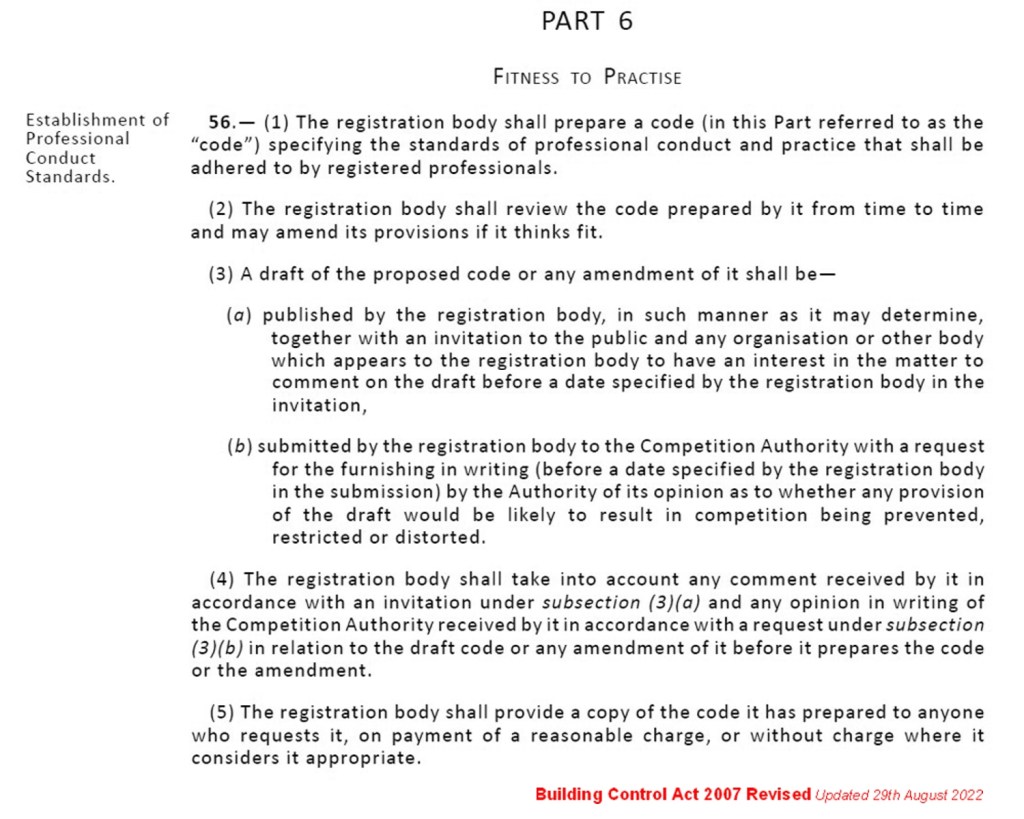
In Section 56[11], the draft of the proposed code[14], or any amendment of it shall be published by the registration body together with an invitation to the public and any organisation that may have an interest in the matter to comment on the draft. Furthermore, the registration body shall take into account any comment received by it in accordance with this invitation, Figure 5.
Engineers Ireland Bye-laws(2012) provides limited governance regarding the publication of the Code of Ethics: “The Council shall publish a Code of Ethics, to be observed by all Corporate and Non Corporate Members. The Council may, from time to time, amend such Code of Ethics as it considers appropriate”.[15] Furthermore, the “reserved duties and powers of Council” includes “final approval of any proposals prepared by the Executive Board in relation to” “changes to the Code of Ethics and disciplinary procedures”.[16] Inconsistent then that the Disciplinary Procedures for Breaches of the Code of Ethics(2023) should include the following text “These procedures may be amended by the Council from time to time” [17], but no reference is provided in the Code of Ethics(2023), which has also failed to acknowledge the obligations on other registration bodies of Prescribed Persons in publishing draft amendments of the Code of Ethics for public consultation.
In 2022, Engineers Ireland undertook a review of the Code of Ethics(2018) saying through a choreographed response that “the review of our Code of Ethics, incorporated a review of a number of similar codes and conduct regulations and feedback from the Engineers Ireland Ethics and Disciplinary Board; Appeal Board; members; as well as two legal reviews.” As we published previously[18], neither the facts nor the documents associated with this review were disclosed to Members of Engineers Ireland. In another publication[19], we confirmed that in the December 2022 Council, Minutes of Meeting:
“the President [2022-2023] advised that the documents related to Item 5 (the Code of Ethics Review) ……were not suitable for circulation and should not be circulated outside of Council”.
This lack of transparency and engagement by Engineers Ireland should be a matter of great concern.
There would appear to be a deliberate intention in the Building Control Act 2007 (Revised 2022) to impose impartiality in the make-up of a “committee” or board. This is particularly obvious in the establishment of the Professional Conduct Committee. In the context of the ‘Architect’, for example, Section 23[11] “provides for the establishment by the registration body of a Professional Conduct Committee to examine complaints made in regard to alleged professional misconduct”[20]. While their respective registration bodies maintain the registers, their Admissions Boards, Technical Assessment Boards, Professional Conduct Committees and Appeals Boards must all be chaired by non-members and a majority of the make-up of those boards must also be non-members of their respective registration body. It is worth noting the balance of the Professional Conduct Committee, Figure 6, five registered architects and six who are not architects, with the chairperson from the legal profession, appointed by the Minister.

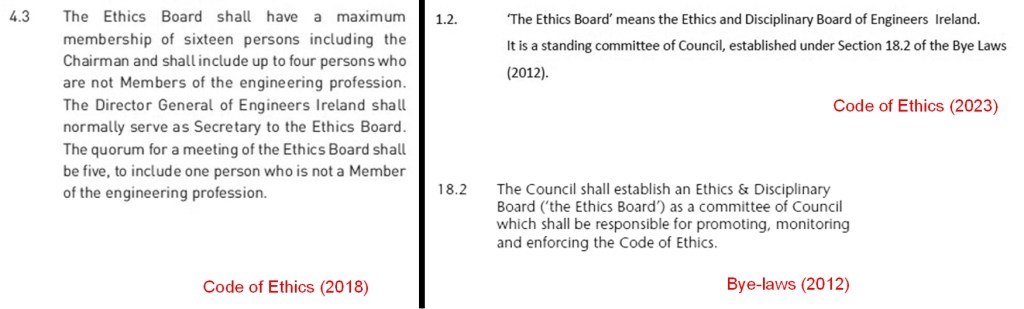
In contrast, the imbalance in the make-up of the Ethics and Disciplinary Board[21] of Engineers Ireland, can only realise a deliberate bias. Composed of a maximum of 16 participants, Figure 7, with only up to 25% being non-Members of Engineers Ireland, and chaired by a Member of Engineers Ireland. Even the quorum is so designed to further embed this bias. In addition, where a complaint is to be investigated upon, at the discretion of the Ethics and Disciplinary Board, the Chairperson shall appoint an Investigative and Disciplinary Panel[22] of “up to three Members of the Ethics Board”[23] and nominate one of those to act as Chairman.
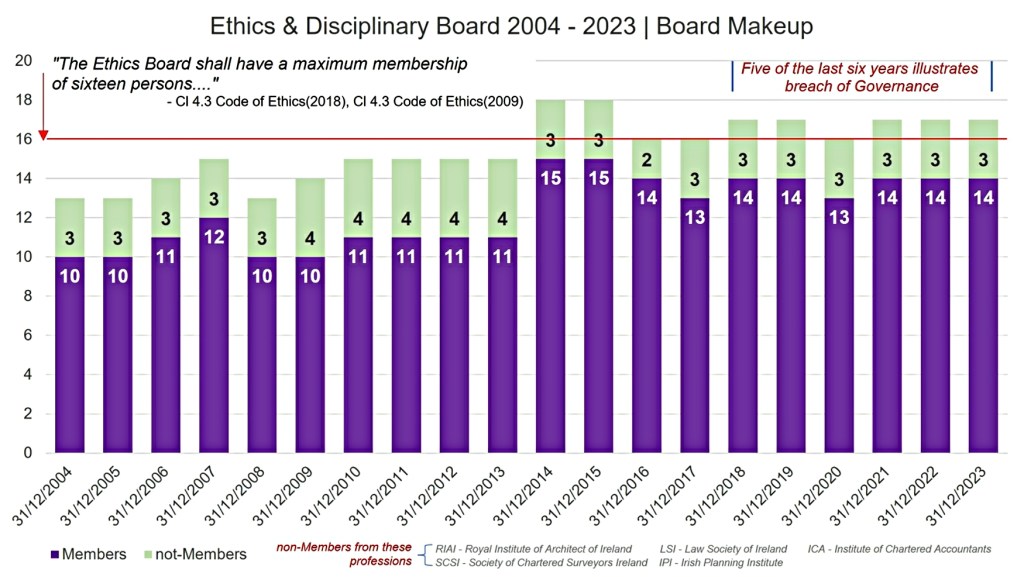
Engineers Ireland has not demonstrated any willingness to realign its governance structures with the legislation under-pining Building Control since the enactment of Building Control Act 2007 (Revised 2022). In 2023 we asked the question who holds Engineers Ireland to account if its Bye-laws are repeatedly ignored? There is a further observation of Engineers Ireland inability to adhere to its own governance criteria, breaching Clause 4.3 of the Code of Ethics(2018) in five of the past six years, Figure 8 . By deleting Clause 4.3[24] in its revision of the Code of Ethics(2023) the motivation appears to be the removal of any descriptive reference to the size and make-up of the Ethics and Disciplinary Board as the reaction when Engineers Ireland was made aware of this governance irregularity.
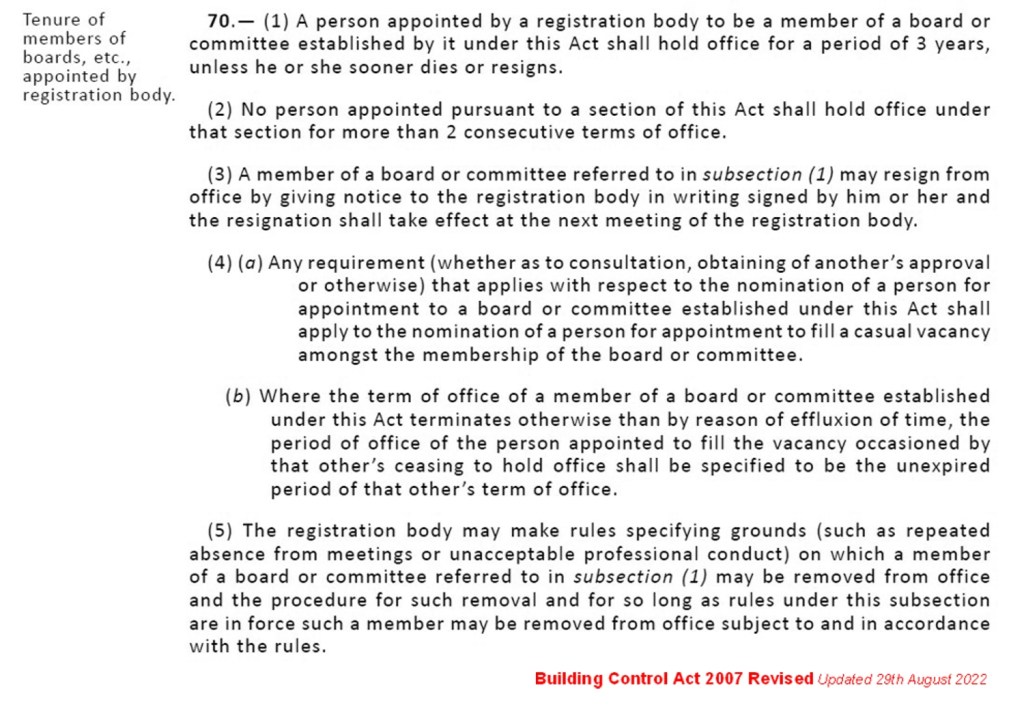
In Section 70[11], no person appointed by the registration body, to be a member of a board or committee shall hold office for more than two consecutive terms of office of three years duration each, Figure 9.
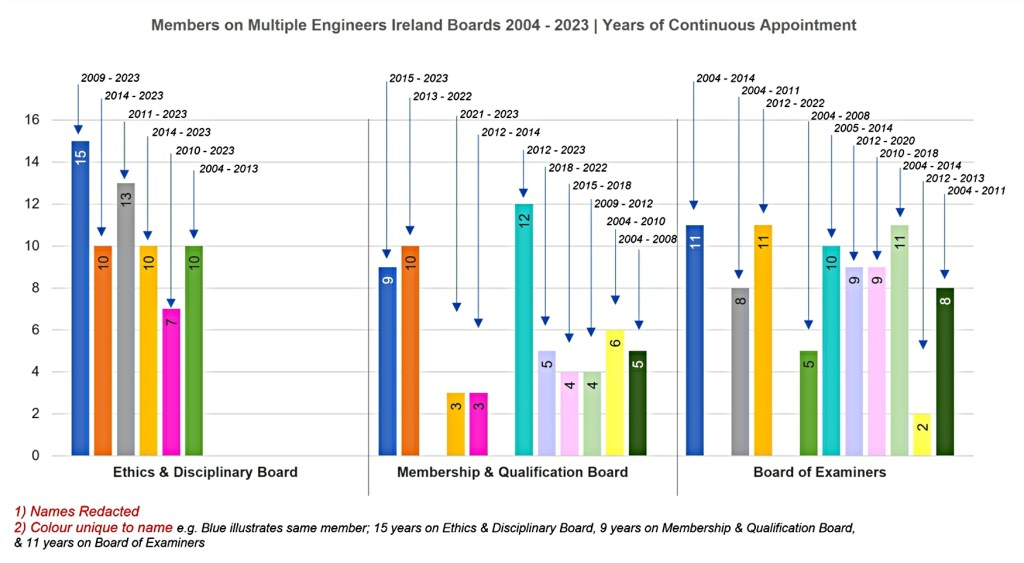
There is no such provision in the published governance documents of Engineers Ireland e.g. Bye-laws(2012) or Code of Ethics(2023) for tenure on the Ethics & Disciplinary Board, or other boards such as the Membership & Qualification Board or the Board of Examiners, a matter that the PwC “wide-ranging” governance review appears to have also overlooked. The Governance Review Final Report[25] from PwC, approved by Council in December 2021, includes a key recommendation 7 “Consider tenure, succession planning and training of Chairs of the key operating Sub-Boards/Committees”. There is no definition of ‘Sub-Board’ in the Bye-laws(2012) so it is unclear what is being referred to here by PwC. Nevertheless, the aforementioned boards are defined[26] as ‘Boards’ and not ‘Sub-Boards’.
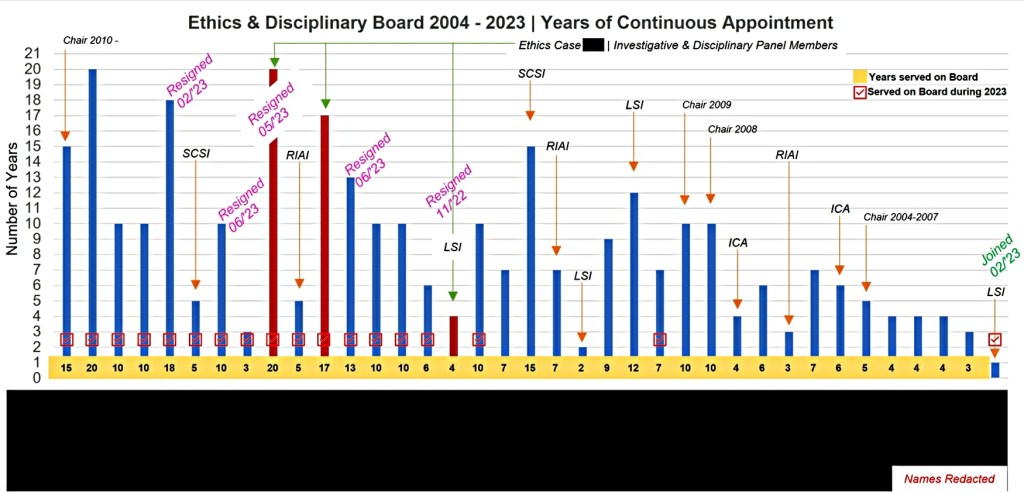
The reality of governance practice at Engineers Ireland is such that the chairperson of the Ethics and Disciplinary Board was appointed in 2010 and has held the position continuously since. The Ethics and Disciplinary Board in 2023 had ten members with more than ten consecutive years of service, three of whom had more than fifteen consecutive years and two with a record twenty consecutive years of service on the Board, Figure 10, illustrating either a complete contempt for the sentiment in the Building Control Act 2007 (Revised 2022) or a complete disregard for good governance.
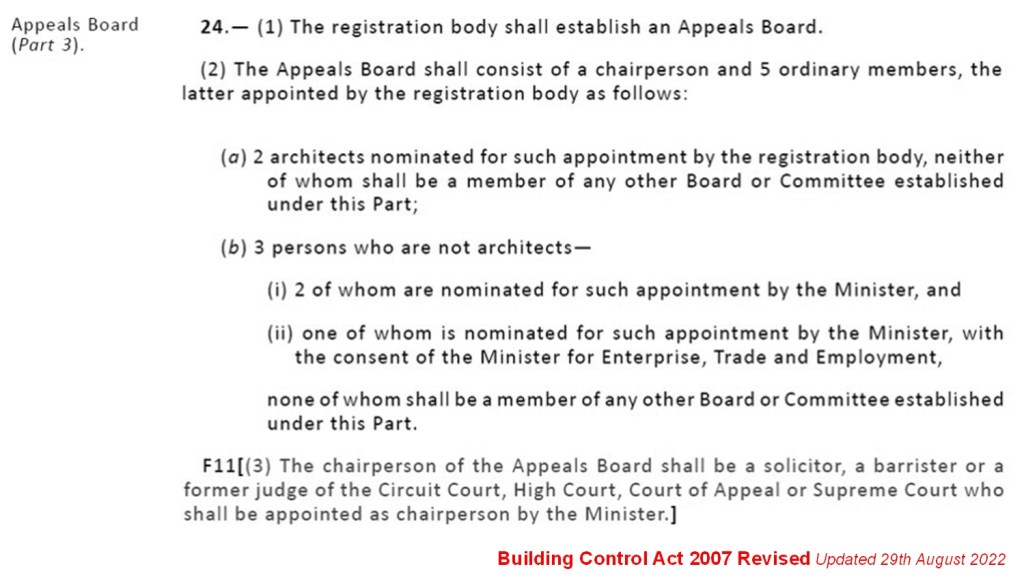
Section 24[11] “provides for the establishment by the registration body of an Appeals Board”. Again, there appears to be a deliberate attempt to impose impartiality in the make-up of the Appeals Board, with only two architects on the board of six persons, Figure 11. Furthermore, in the establishment of the Appeals Board by the registration body, sub-section 2(a) goes further in stipulating that the “2 architects nominated for such appointment by the registration body, neither of whom shall be a member of any other Board or Committee established under this Part”.
Engineers Ireland Code of Ethics(2018) made provision for the make-up of the Appeal Board[27], Figure 12. When compared to the prescribed composition of the aforementioned boards of other registered bodies, there is a real perception of ‘cronyism’ about the Engineers Ireland Appeal Board.
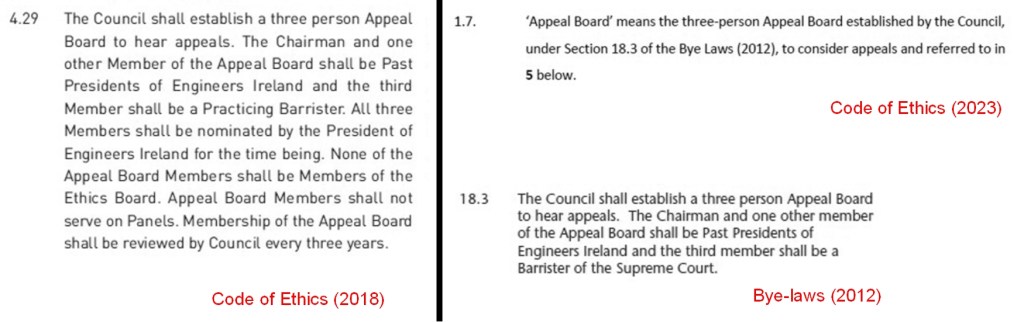
The implications of the 2023 revision to Engineers Ireland Code of Ethics, is effectively the abandonment of governance and a complete divergence from the industry standards established[11] for the other Prescribed Persons. Not only has Engineers Ireland removed any reference to the make-up of the Ethics Board[23] by deleting Clause 4.3[24], it has also deleted Clause 4.29[24], which had the provision for Council to exercise its powers to review the membership of the Appeal Board every three years. It has reverted back to the provision in its Bye-laws(2012):
“The Council shall establish a three person Appeal Board to hear appeals. The Chairman and one other member of the Appeal Board shall be Past Presidents of Engineers Ireland and the third member shall be a Barrister of the Supreme Court.” [28]
While the balance of Engineers Ireland’s Appeal Board has always been inconsistent, there is a deliberate embedded bias.
- The chairman shall be a past president of Engineers Ireland
- A second member of the three-person Appeal Board shall be a past president of Engineers Ireland.
If, for example, a Complaint of Professional misconduct was to be taken against a President / Past President of Engineers Ireland, the decision of the Appeal Board which is by simple majority[29] would be obvious.
Reality of Engineers Ireland Appeal Process
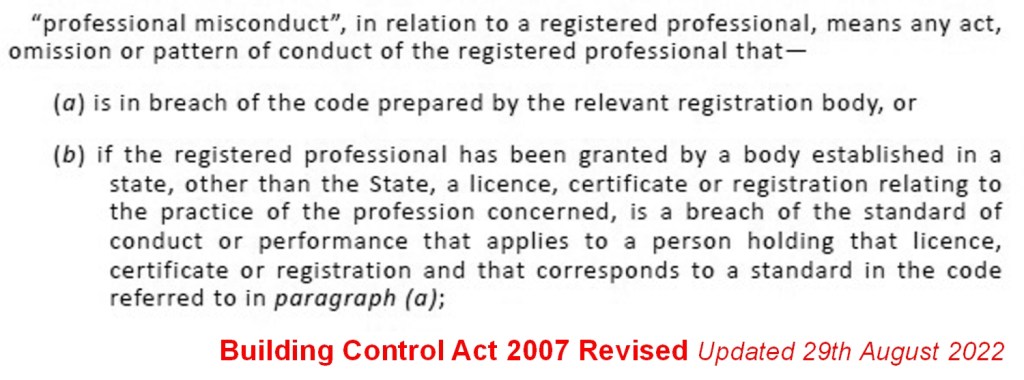
According[30] to the Building Control Act 2007 (Revised 2022), “‘poor professional performance’, in relation to a registered professional, means any failure of the registered professional to meet the standards of competence that may reasonably be expected of registered professionals practising the profession concerned.” What is of particular interest, is the how the Building Control Act 2007 (Revised 2022) defines ‘Professional misconduct’, Figure 13.
The opinion of the Appeal Board of Engineers Ireland in a recent judgement of a case of Professional misconduct[31], defined specifically by Clause 3.1 of its Code of Ethics(2018), Figure 14, considered that while the “normal standard of proof to be applied in cases under the Code of Ethics[32] will usually be the less onerous standard known as the Civil Standard, i.e., where the facts must be proven on the balance of probabilities”.
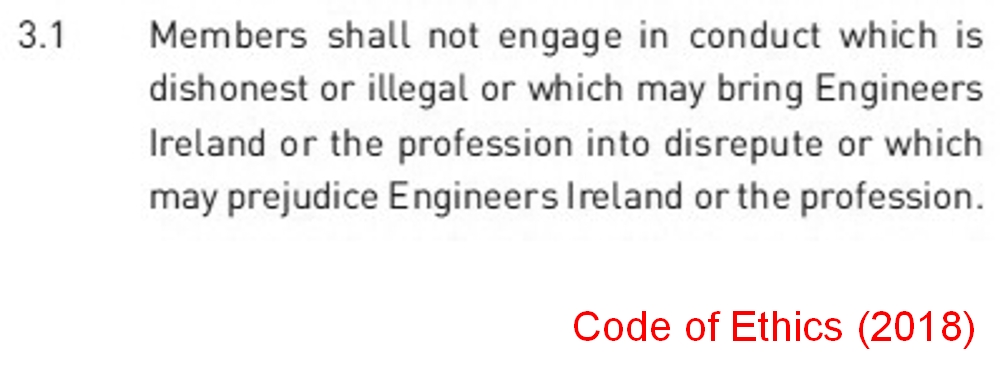
However, in the aforementioned judgement, the Appeal Board was “satisfied that in appropriate cases, particularly where such allegations of fraud or dishonesty are made, that it would be more appropriate to apply the Criminal Standard of proof. The Appeal Board is satisfied that before any finding of professional misconduct can be made against a Member the conduct in question must be regarded as serious.”
It would appear therefore, that depending on who the Member is, the application of the Civil Standard of proof or the Criminal Standard of proof is at the discretion of the Appeal Board in matters of Professional misconduct. It is worth remembering the Appeal Board comprises two past presidents of Engineers Ireland, one of whom is Chairman. The third member is a Barrister, all of whom are nominated by the President of Engineers Ireland. Decisions of the Appeal Board are made by simple majority.[33]
We are guided in the Code of Ethics(2018) that;
“In hearing an appeal the Appeal Board shall, for the purposes of its functions, have the same powers as are vested in the Panel[34] by Clause 4.14 hereof and the same obligations as are required of the Panel under Clause 4.15(a), (b) and (c).” [35]
It is reasonable to conclude[36] that sub-clauses (a), (b) and (c) cannot be read in isolation of the obligations in Clause 4.15 itself, in particular; “The Panel[34] shall adjudicate upon the complaint fairly and impartially and in accordance with the requirements of natural and constitutional justice….” should also apply to the Appeals Board, Figure 15.
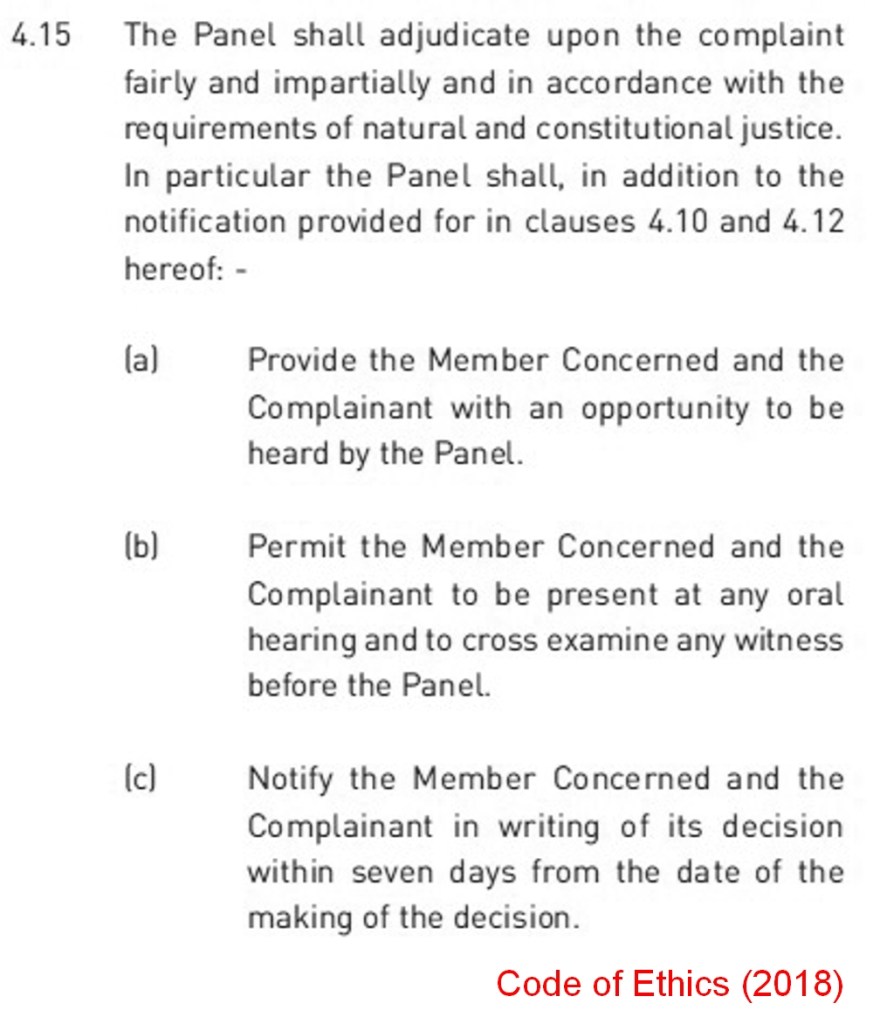
The 2023 revision to the Code of Ethics, categorically dispels this interpretation. While “the Panel[34] shall adjudicate upon the complaint fairly and impartially, and in accordance with the requirements of natural and constitutional justice” [37], “the Appeal Board has no obligation to comply with any general guidelines which may have been issued by the Ethics Board[23] in respect of the conduct of proceedings by Panels”[38]. This is remarkable notwithstanding, the responsibilities of the Ethics Board, see Figure 7, as defined in Cl 18.2 Bye-laws(2012) which “shall be responsible for promoting, monitoring and enforcing the Code of Ethics”, a clause relied upon in the Disciplinary Procedures for Breaches of the Code of Ethics(2023).
The opinion of the Appeal Board of Engineers Ireland in the recent judgement of Professional misconduct, clarified its role, when it stated; “It is important to observe that, in the context of a disciplinary inquiry, the rules of fair procedures are there primarily to protect the person against whom an allegation of professional misconduct is made.”
Section 69[11] defines the procedure for the nomination of persons for appointment by the registration body to any Board or Committee, Figure 16. The nomination (excluding first appointments) shall be by means of an election in accordance with bye -laws made by the body, with the consent of the Minister.
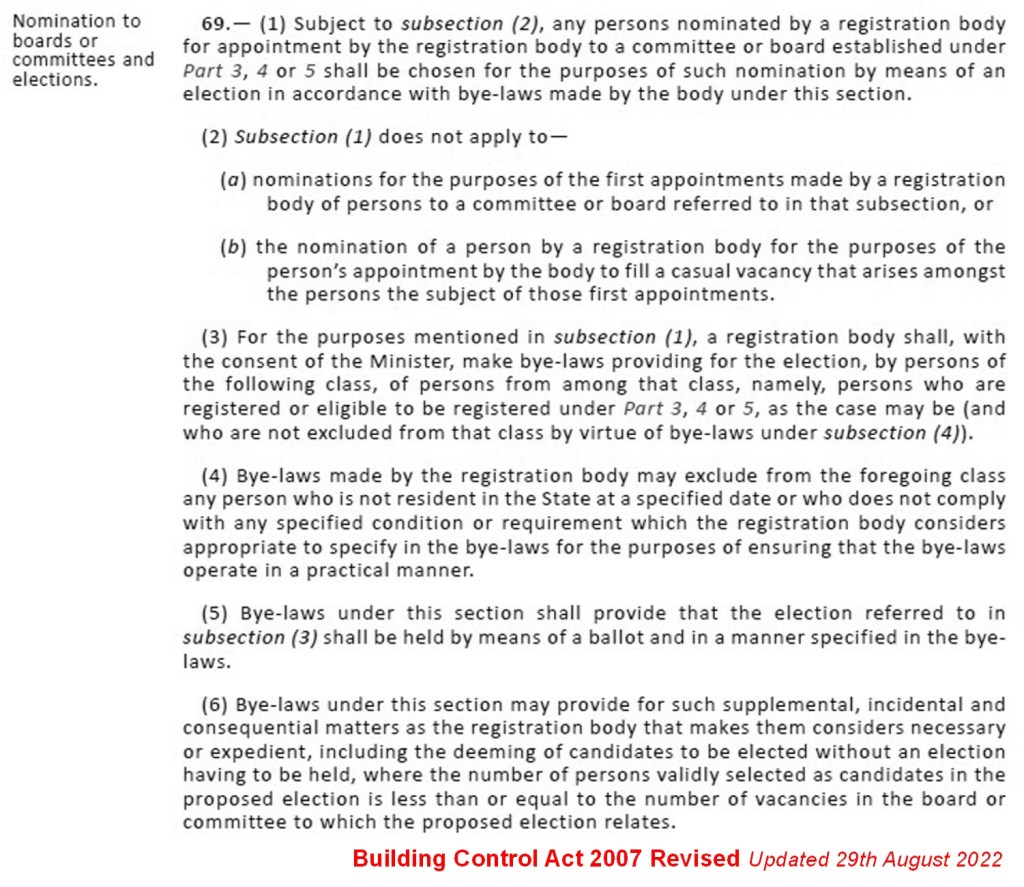
There is no provision in the published governance documents of Engineers Ireland e.g. Bye-laws(2012) or Code of Ethics(2023) for nomination of persons for appointment to the ‘Ethics and Disciplinary Board’, or other boards such as the ‘Membership and Qualification Board’ or the ‘Board of Examiners’, a matter that the PwC “wide-ranging” governance review appears to have also overlooked. While volunteerism by its members is commendable, longevity of service, particularly on the same board or across multiple boards, Figure 17, is unhealthy, demonstrates a lack of governance and facilitates the issues we have exposed.
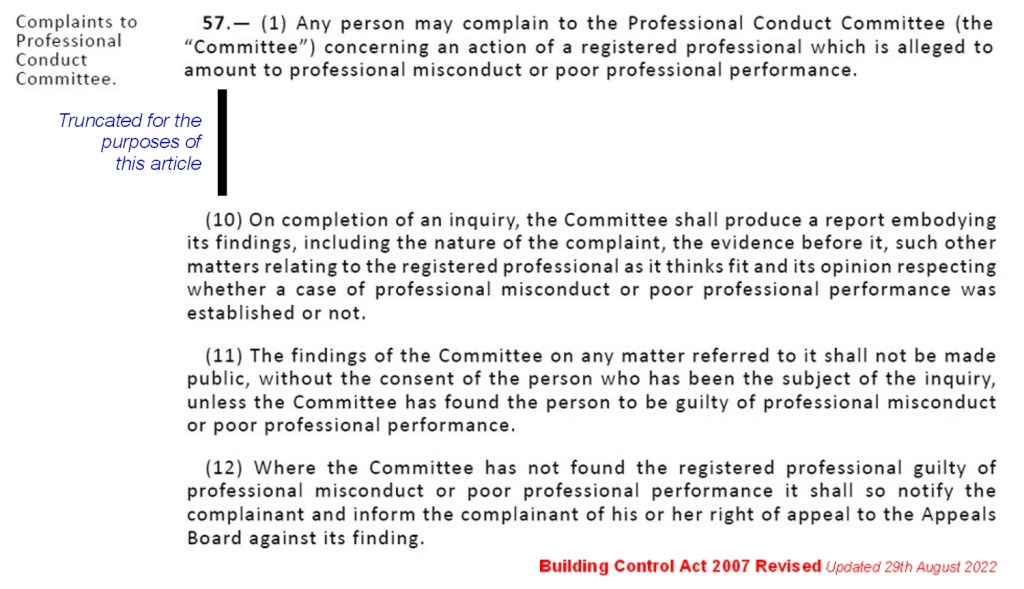
In Section 57[11], any person may complain to the professional conduct committee regarding a matter of alleged Professional misconduct or poor professional performance by a registered professional, Figure 18. Sub-section 12 puts the onus on the professional conduct committee, to not only notify the complainant of its findings and in the case of there being a finding of no professional misconduct, inform the complainant of his or her right of appeal to the Appeals Board against its finding.
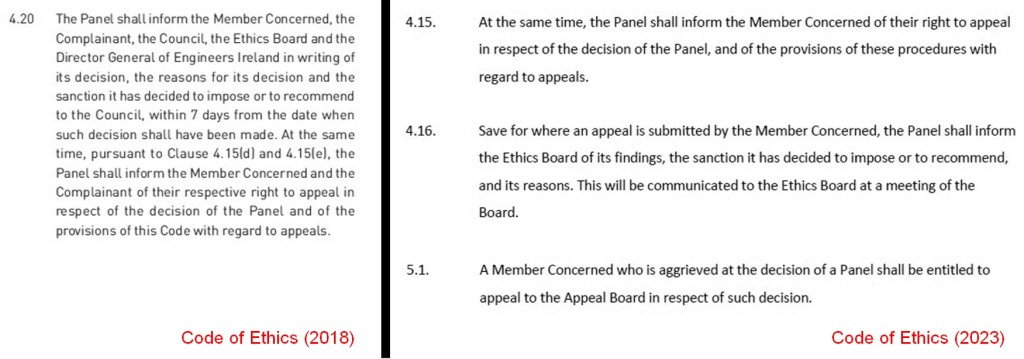
With respect to Engineers Ireland’s complaint procedures, the obligation[39] on the Investigative and Disciplinary Panel[22] to inform the Member Concerned[40] and the Complainant[41] of their respective right to appeal in respect of the decision of the Investigative and Disciplinary Panel is provided for in the Code of Ethics(2018) and generally complies with the sentiment outlined in Section 57[11].
However, an extraordinary revision in the Disciplinary Procedures for Breaches of the Code of Ethics(2023) now confines the right of the appeal to the Member Concerned only[42], Figure 19. The Complainant[41] has no recourse to the decision of the Investigative and Disciplinary Panel.
It is important to reiterate; the Council of Engineers Ireland unanimously approved this revision at its Council meeting on 3rd December 2022.
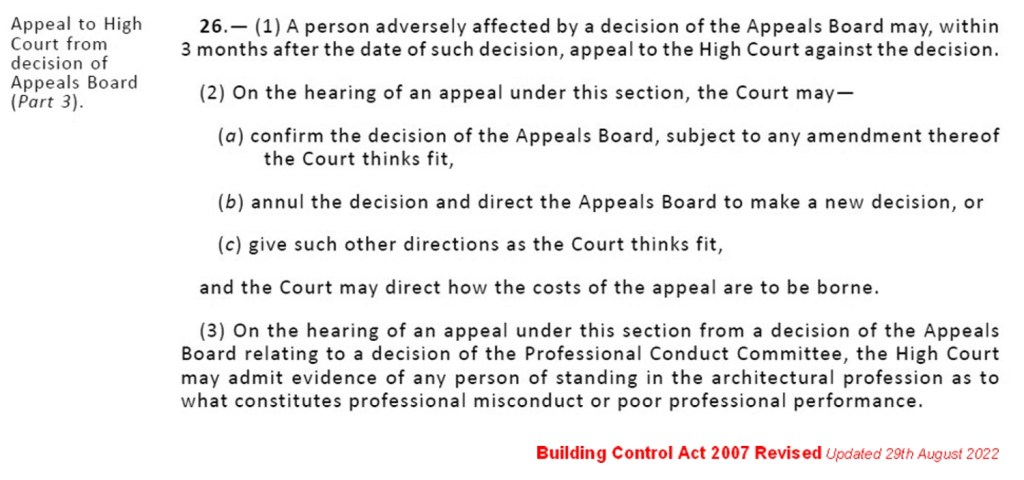
Section 26[11] “provides for the right of appeal to the High Court by persons adversely affected by a decision of the Appeals Board”, Figure 20.
Since the introduction of the Code of Ethics, approved by Council of the Institution on 22nd November 2003, there has never been any recourse to the Courts in the governance procedures of Engineers Ireland for persons adversely affected by a decision of the Appeal Board. The decision of the Appeal Board has always been stated as final[43]. Until recently, having been informed of the Appeal Board’s decision, “the Council shall formally endorse the decision of the Appeal Board and shall accept such decision as its final position on the matter and shall act accordingly” [44]. The replacement of Section 4[24] with the introduction of Disciplinary Procedures for Breaches of the Code of Ethics(2023) has not only removed the function of Council in this regard, but Council is not even formally notified of an Appeal Board’s decision[45].
It is remarkable that the Council of Engineers Ireland were complicit in abolishing the requirements of natural and constitutional justice of not only the public to have recourse, but also of fellow members of the Institution. Furthermore, the choreographed response alluded to earlier, stated the Code of Ethics review incorporated “two legal reviews”. While Clause 8.2 of the Disciplinary Procedures for Breaches of the Code of Ethics(2023) states that “At all times, efforts will be made to comply with fair procedures”, you will begin to appreciate why the following text, which existed in previous revisions of the Code of Ethics(2018) was erased from the latest revision of the Code of Ethics(2023):
“This Code has been drawn up with the principles of natural justice in mind. Such principles shall be followed by all parties in implementing and interpreting the Code.”
Impact of Council’s Unanimous Approval
Consider the recently published article by The Ditch on 15th August 2024 regarding the State’s involvement in the downgrading of applications of home-owners under the Defective Concrete Block scheme where Chartered Engineers acting on behalf of affected home-owners were required to submit draft applications and receive guidance from the State appointed engineers contracted to the Housing Agency before final reports were accepted.
It has been confirmed to Conscientious Observers that both the Chartered Engineer acting on behalf of an affected home-owner and the Chartered Engineer appointed by the State working on behalf of the Housing Agency are both on the same IS 465 Register at Engineers Ireland where according to its website “This register lists Chartered Engineers who have the necessary direct professional experience, competence and specialist training in accordance with the requirements set out in I.S. 465:2018 – Assessment, testing and categorisation of damaged buildings incorporating concrete blocks containing certain deleterious materials’. Engineers on the register can be contacted directly, you will find their contact details on their CVs.”
“To lead the transformation of the building industry, we know that how we make our decisions is as important as the decisions themselves”[46]
It would not be unreasonable for the Chartered Engineer acting on behalf of the affected home-owner, in such a case to believe that in, providing their “professional opinions that distinguish between facts, assumptions, and opinions” [47], their “honesty and integrity” [48] has been brought into disrepute through what appears to be “situations and circumstances in which there is a conflict of interest” [49] involving State appointed Chartered Engineers.
Fundamentally, “A member’s obligations to the client can never override their responsibility to the public good, and members of Engineers Ireland should not enter undertakings which compromise this responsibility.” [50]
In such circumstances, Clause 1.2 in the Code of Ethics(2018), which has been erased from the Code of Ethics(2023) has relevance:
“In their relations with other engineers and professional Colleagues, Members shall respect their dignity and professional standing and shall do nothing directly or indirectly to injure maliciously their reputation, practice, employment or livelihood.” [51]
If this Chartered Engineer, a Member of Engineers Ireland, acting on behalf of the affected home-owner, were to take a case of Professional misconduct against the State appointed Chartered Engineer on the above grounds, or if the home-owner were to take their own case of Professional misconduct against the same individual:
- Neither has a right to appeal under the appeals process[52]. This is completely contrary to the provisions in the Building Control Act 2007 (Revised 2022) for Prescribed Persons from other registration bodies. The right to appeal was present in the Code of Ethics(2018). What, therefore, prompted Engineers Ireland to limit the right to appeal to the Member Concerned?
- While this right to appeal was available to both parties[53] the opinion of the Appeal Board of Engineers Ireland in its recent judgement of Professional misconduct, clarified its interpretation, when it stated; “It is important to observe that, in the context of a disciplinary inquiry, the rules of fair procedures are there primarily to protect the person against whom an allegation of professional misconduct is made.” Regardless of this provision, and the obligations at the outset that the “principles [of natural justice] shall be followed by all parties in implementing and interpreting the Code”, proof now exists, beyond reasonable doubt that Engineers Ireland is incapable of adhering to its own governance procedures with impartiality.
Engineers Ireland and Building Profession
We have already exposed the credibility of Engineers Ireland Governance Review undertaken by PwC, but in light of what has been presented in this article it is worth quoting again what the final report[25], dated 14th November 2022, ’Update from the Governance Review Implementation Oversight Group’ concluded:
“A reminder that the PwC findings were favourable, suggesting only a few relatively minor amendments were recommended for the Institution. This is a positive reflection on the standing of the Institution and the governance controls already in place.”
This article has clearly demonstrated that Engineers Ireland Code of Ethics(2023) and the Disciplinary Procedures for Breaches of the Code of Ethics(2023) as credible governance documents, are not fit for purpose.
- The complete lack of transparency in the process of revising the Code of Ethics(2023). The stage-managed farcical engagement with Members, orchestrated to fulfil the false narrative and secure the ‘unanimous’ approval by Council, demonstrating a culture that prohibits dissenting voices or public engagement.
- An Institution that doesn’t treat Members equally: In a case of Professional misconduct if both the Complainant[41] and Member Concerned[40] are Members of Engineers Ireland, since the introduction of the 2023 revision to the Code of Ethics, only the Member Concerned has the right to Appeal. Even though both parties had the right to appeal in previous revisions of the Code of Ethics, proof has been provided that the Appeal board will ‘protect’ the Member Concerned – “the person against whom an allegation of professional misconduct is made”.
- It is incumbent on the Council of Engineers Ireland to immediately revoke these governance documents and replace with a new Code of Ethics which restores and enhances the Environmental and Social Obligations in Code of Ethics(2018) using a process of complete transparency and meaningful engagement, and a new Disciplinary Procedures for Breaches of the Code of Ethics which is more consistent with the strictures in the Building Control Act 2007 (Revised 2022) for other Prescribed Persons.
- If there is resistance to reform from Engineers Ireland, is it time for the legislators, as a matter of public interest, to insist that Engineers Ireland lose its autonomy adjudicating on matters of ‘Professional Standards’, in relation to a registered professional, and be incorporated in an additional Part to the Building Control Act 2007 (Revised 2022)?
- To appreciate the significance of these issues, and the manner in which Engineers Ireland adjudicates complaints of Professional misconduct, ignoring the very governance procedures it advocates, should the Minister, in the interest of public safety, not seek a judicial review, for example, of the Engineers Ireland Ethics Case referred to in this article?
Finally, it would be remiss of us not to call to action the Chartered Engineering community, since the integrity of this Registered title is at stake; a title “considered to be the gold standard of the profession.”[54]
“Will so many of us continue to turn inward, allowing some form of domination to drag us down? Or will we break out of this downward spiral, for the sake of a sustainable future?” [55]
“Put differently, we have gotten into our predicament today because of a way of thinking that focuses on parts and neglects the whole.” [56]
Don’t let apathy be your intergenerational legacy.
[1] Judt, Tony. “Ill Fares the Land”; 2011
[2] 2.47; 113.3; 113.20; 113.21 GRENFELL TOWER INQUIRY: PHASE 2 Report Overview Report of the PUBLIC INQUIRY into the FIRE at GRENFELL TOWER on 14 JUNE 2017
[3] https://www.bbc.com/news/articles/c049yvrd5qxo
[4] The Institution of Civil Engineers of Ireland (Charter Amendment) Act 1969 (No. 1 (Private) of 1969)
[5] https://www.irishstatutebook.ie/eli/1996/si/397/made/en/print
[6] https://www.irishstatutebook.ie/eli/2011/si/96/made/en/print
[7] https://www.irishstatutebook.ie/eli/2014/si/9/made/en/print
[8] https://www.gov.ie/en/collection/c450a-engineering-services-in-local-authorities-qualifications/
[9] Pg. 1, Building Control Bill, 2005; Explanatory Memorandum
[10] 2005/36/EC of 7th September, 2005
[11] Building Control Act 2007 (Revised 2022)
[12] The Institution of Civil Engineers of Ireland (Charter Amendment) Act 1969 (No. 1 (Private) of 1969)
[13] Disciplinary Procedures for Breaches of the Code of Ethics
[14] “Standards of professional conduct and practice that shall be adhered to by registered professionals” Cl 56.(1), Building Control Act 2007 (Revised 2022)
[15] Cl 18.1 Bye-laws(2012)
[16] Cl 3.1.3(iii) Bye-laws(2012)
[17] Cl 8.3 Disciplinary Procedures for Breaches of the Code of Ethics(2023)
[18] Engineers Ireland and ‘similar’ Professional Organisations
[19] Engineers Ireland U-turn on ethical obligation to tackle climate change and biodiversity loss
[20] Pg. 6, Building Control Bill, 2005; Explanatory Memorandum
[21] Cl 4.2, Cl 4.3 Code of Ethics(2018); Cl 1.2 Disciplinary Procedures for Breaches of the Code of Ethics(2023); Cl 18.2 Bye-laws(2012)
[22] Cl 4.5, Cl 4.6 Code of Ethics(2018); Cl 4.1, Cl 4.2 Disciplinary Procedures for Breaches of the Code of Ethics(2023)
[23] ‘The Ethics Board’ means the Ethics and Disciplinary Board[21]
[25] It would appear since we published “Who holds Engineers Ireland to account if its Bye-laws are repeatedly ignored?” on 20th June 2023, Engineers Ireland has taken measures preventing public access to any of the referenced documents, further demonstrating its quest for being a non-transparent Institution.
[26] Cl 8.2 Bye-laws(2012)
[27] Cl 4.29 Code of Ethics(2018)
[28] Cl 18.3 Bye-laws(2012)
[29] Cl 4.35 Code of Ethics(2018); Cl 5.9 Code of Ethics(2023)
[30] https://www.irishstatutebook.ie/eli/2007/act/21/enacted/en/print.html
[31] “‘Professional misconduct’ means conduct which, in the opinion of the Panel or the Appeal Board, as the case may be, constitutes conduct which is a breach of the Code of Ethics or, as the case may be, of the Institution’s Standards of Professional Conduct in force at the time the said conduct occurred.” Code of Ethics(2018)
[32] The revision of the Code of Ethics referred to in this instance is Code of Ethics(2018)
[33] Cl 4.34 Code of Ethics(2018); Cl 5.9 Code of Ethics(2023)
[34] ‘Panel’ means an Investigative and Disciplinary Panel[22]
[35] Cl 4.33 Code of Ethics(2018)
[36] On Pg. 1 of Code of Ethics(2018) it states; “This Code has been drawn up with the principles of natural justice in mind. Such principles shall be followed by all parties in implementing and interpreting the Code.”
[37] Cl 4.9 Code of Ethics(2023)
[38] Cl 5.8 Code of Ethics(2023)
[39] Cl 4.20 Code of Ethics(2018)
[40] “‘The Member Concerned’ means a Member of Engineers Ireland against whom a complaint has been made.” Code of Ethics(2018)
[41] “‘The Complainant’ means a person who has made a complaint of professional misconduct against a Member to the Ethics Board23, or in the case of a complaint made by the Ethics Board under Clause 4.2 (b) hereof, means the Ethics Board itself.” Code of Ethics(2018)
[42] Cl 4.15, Cl 4.16, & Cl 5.1 Code of Ethics(2023)
[43] Cl 4.36 Code of Ethics(2018), Cl 5.9 Code of Ethics(2023)
[44] Cl-4.36 Code of Ethics(2018)
[45] Cl 5.10 & Cl 5.11 Disciplinary Procedures for Breaches of the Code of Ethics(2023)
[46] US Green Building Council Guiding Principle
[47] Cl. 6 Code of Ethics(2023)
[48] Cl. 12 Code of Ethics(2023)
[49] Cl. 7 Code of Ethics(2023)
[51] Cl 1.2 Code of Ethics(2018)
[52] Cl 5.1 Disciplinary Procedures for Breaches of the Code of Ethics(2023)
[53] Cl 4.20 Code of Ethics(2018)
[54] https://www.engineersireland.ie/Resources/Documents/resource/424
[55] Mintzberg, Henry. “Rebalancing society”; 2015
[56] Senge, Peter. “The Necessary Revolution”; 2008





 Conscientious Observers