

Students of Macbeth[1] will be familiar with Shakespeare’s infamous development of the art of equivocation; “the practice of deliberately deceiving a listener without explicitly lying, either by using ambiguously misleading language or by withholding crucial information.”
Perhaps, the fruits of Shakespeare’s works have had a greater impact on the learned than could ever have been anticipated by those responsible for the development of educational curricula over the decades. The 21st Century is in its infancy and already it is awash with ‘actors’ of equivocation. In recent years Engineers Ireland would appear to have nurtured the art of equivocation particularly at its Annual General Meetings.
An Annual General Meeting (AGM) is a meeting of members of an organisation at which the members can ask questions and get information about the organisation. Indeed, one of the reserved duties and powers of the Council of Engineers Ireland, as set out in Clause 3.1.3(vii) of the Bye-laws(2012) is “Preparation of an Annual Report for the Annual General Meeting and for members, incorporating an Annual Report of the Executive Board”. Furthermore, Clause 3.3.2 of the Bye-laws(2012) specifically places accountability for such matters with the President of Engineers Ireland:
“The President, as Chairman of Council, shall be responsible for the integrity of processes of Council, the Executive Board and Special and Annual General Meetings….”
Annual General Meeting 2021
The following examples will attempt to illustrate the context for this article. When asked how many engineers (Members) were on the staff in Engineers Ireland, at recent Engineers Ireland Annual General Meetings, the responses were less that forthcoming:
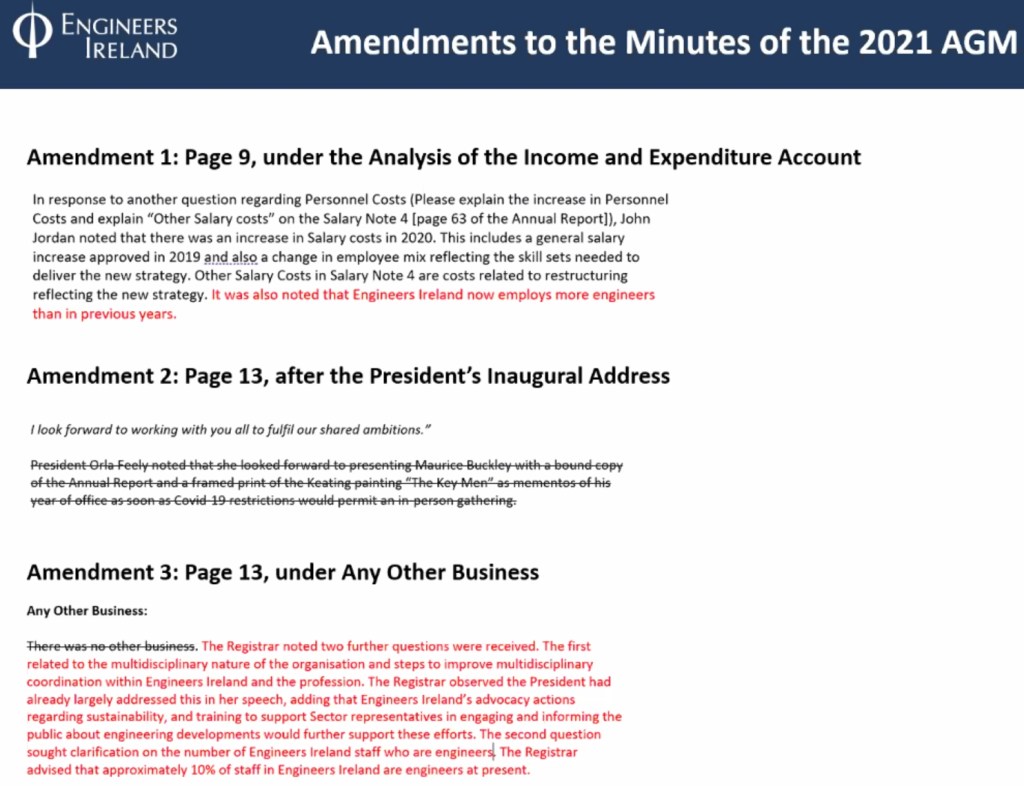
“We now have more engineers employed in Engineers Ireland than ever before…” – Chairman of the Finance Committee {AGM 2021}
This was later qualified during the AGM by the Registrar (2010-2022): “So about 10% of our workforce in Clyde Road are engineers at the moment.” Both of these statements were omitted from the Minutes of Meeting until brought to the attention of the President (2021-2022) and the Director General (2015-2022) as shown in the next Figure.
Annual General Meeting 2022
Similar questions were submitted ahead of the Annual General Meeting 2022 to which the following response was provided during the AGM:
“Just in terms of staff, I know there was a question about the number of engineers on staff so I’ll take the opportunity now to clarify so we have 49 staff in Engineers Ireland and the whole time equivalent of that is 46.45. ……. Of those seven are engineers. …… So, 15% of the staff are engineers, which is quite a change, because when I started in 2015 two members of staff were engineers.” – Director General (2015-2022) {AGM 2022}
With ambiguous statements such as “more engineers employed…than ever before”, and “so about 10% of our workforce”, provided at the AGM 2021, a behaviour that was to be repeated again at the AGM 2022, the Director General (2015-2022) was then asked to provide the names of those employees who were engineers. This was not seen as an unusual request, since all the employees’ names had already been listed in the Annual Report. The Director General (2015-2022) agreed to follow-up on the request. Some weeks later the Director General (2015-2022) did follow-up but in so doing chose to use GDPR as the reason to avoid answering the question raised at the AGM 2022, as follows:
“As a Data Controller, Engineers Ireland has the legal obligation and therefore responsibility to not disclose staff qualifications (personal data) without staff’s (the data subjects) explicit consent. Employees submitted their qualifications solely in support of their application for their role with Engineers Ireland and the information cannot be used for any other purpose without the employee’s express consent.” – Director General (2015-2022)
The Director General (2015-2022) was never asked for the qualification details of any employee, e.g., which discipline the degree was in, year of qualification, grade, etc. No, all of the employees were already listed in the Annual Report, the simple request was to identify those in that list who were engineers. In an ethical context, this approach is reminiscent of an act that deceives by stating a true statement that is irrelevant or leads to a false conclusion.
A bill of good health
What therefore is motivating the leadership in Engineers Ireland to adopt this behaviour?
In the Statement of Strategic Intent 2021-2023 Engineers Ireland “promise to approach its work with specific behaviours” which are underpinned by its stated values. We have already demonstrated in ‘Walking the Talk‘ how the actions taken by Engineers Ireland frequently make its statements about core values appear as worthless ‘sound-bites’.
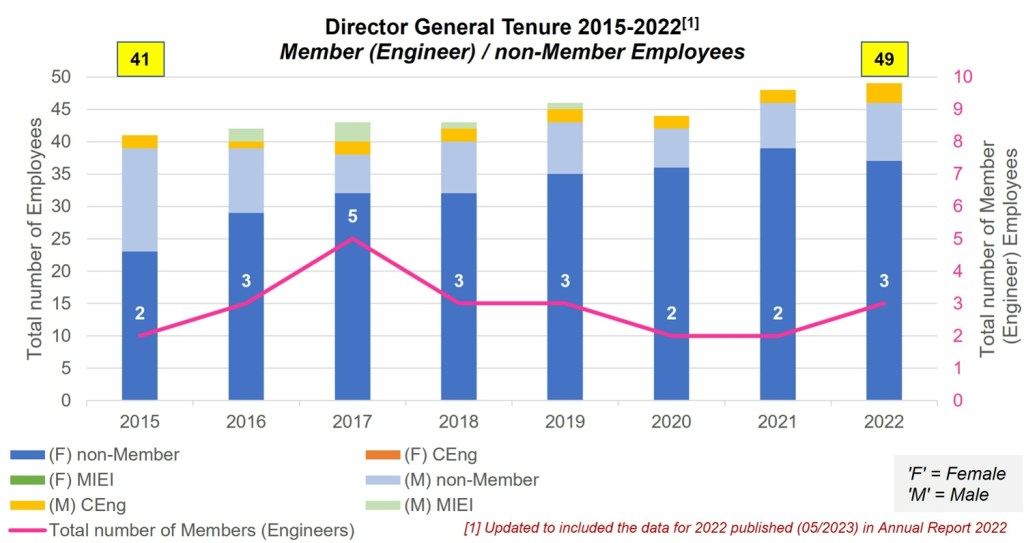
Members of Engineers Ireland are generally those engineers that have met the criteria to become Ordinary Members (MIEI) and those that have progressed to the Registered Title of Chartered Engineer (CEng). This next Figure shows the Members (engineers) of Engineers Ireland on its staff listed in each of the Annual Reports over the seven-year period. The Engineers Ireland ‘Members’ database and LinkedIn was used to validate this information.
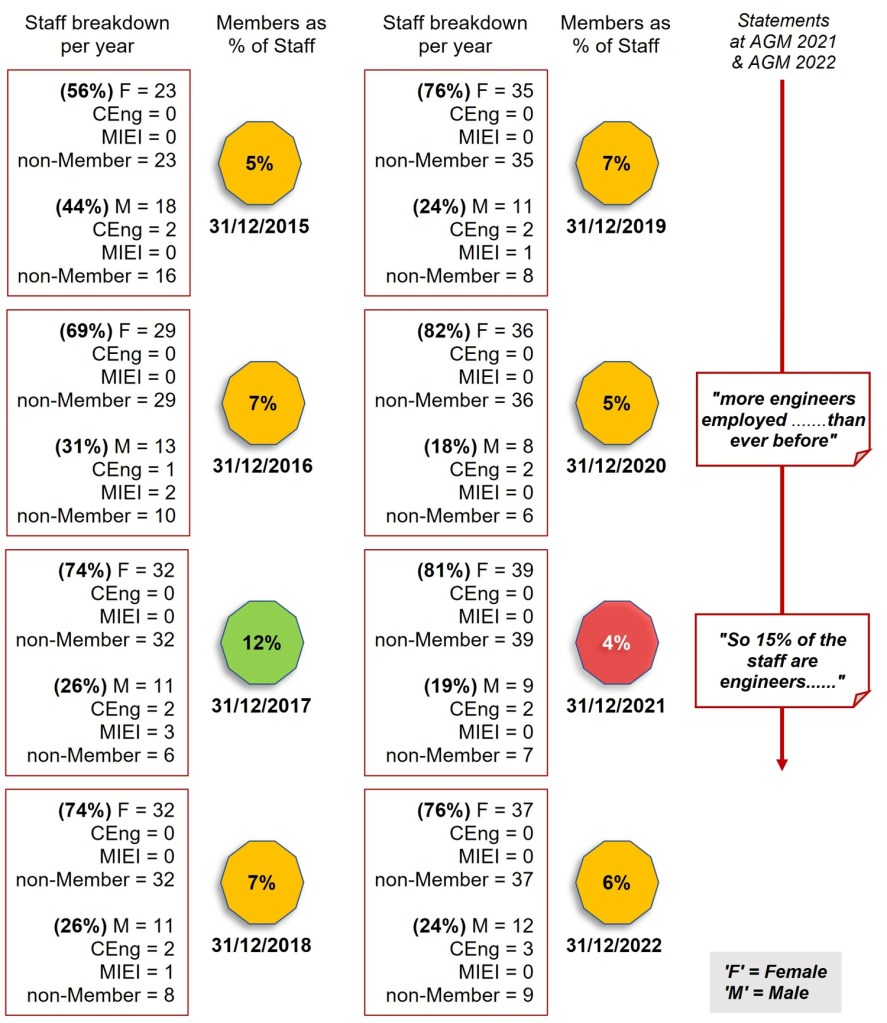
A further breakdown is provided in the next Figure, highlighting the percentage of staff that are Members (engineers) of Engineers Ireland.
The Transparency of data
- At the AGM 2021, the Chairman of the Finance Committee stated that there were “more engineers employed in Engineers Ireland than ever before…”.
- Our research shows that during the tenure of the Director General (2015-2022) there were in fact more Members (engineers) employed in 2017 than in any other year.
- At the AGM 2021, the Registrar (2010-2022) qualified the remark of the Chairman of the Finance Committee by saying “about 10% of our workforce in Clyde Road are engineers at the moment.”
- Does “at the moment” refer to the reporting period date of 31st December 2021 or the date of the AGM 2nd June 2022?
- At the AGM 2022, the Director General (2015-2022) stated that there were “49 staff in Engineers Ireland”.
- There are only 48 listed in the Annual Report 2021 for the reporting period of the AGM.
- At the AGM 2022, the Director General (2015-2022) stated “15% of the staff are engineers, which is quite a change, because when I started in 2015 two members of staff were engineers.”
- There were two members of staff that were also Members (engineers) of Engineers Ireland in 2015 (5% of the staff) and there are only three Members (engineers) of Engineers Ireland at the end of 2022 (6% of the staff). There were five members of staff that were also Members (engineers) of Engineers Ireland in 2017 (12% of the staff).
- During the tenure of this Director General (2015-2022) not one woman Member (engineer) of Engineers Ireland has been listed on the staff in any of the seven Engineers Ireland Annual Reports. This is an extraordinary legacy despite the 69.6% increase in women on the staff in Engineers Ireland; 23 in 2015 to 39 in 2021.
With the internal appointment of the current Director General (2022-), (Registrar 2010-2022) should we expect any change in behaviour at the upcoming AGM 2023?
Authority with Accountability
“What makes our society tick, aside from good governance and competence”, Bennett[2] contends, “is good character. And good character is not some abstraction. It is one of those tangible, very real human attributes that we know, and appreciate, when we see it.” He says, “character education depends not only on the articulation of ideas and convictions, but on the behaviour of those in authority.”
Trust as we outline in ‘Walking the Talk‘ is built on transparency and accountability. Transparency serves little purpose if the information is inaccessible preventing individuals {in this case Members of this Engineering Institution} from judging the trustworthiness for themselves by assessing its quality and differentiating fact from falsehood.
Annual General Meeting 2023
Will it be ‘business as usual’ at the next Engineers Ireland AGM? Would Members not like to know the answers to these questions at the very least?
- Is Engineers Ireland including engineering staff from other organisations, such as Information Technology / Web development service providers to arrive at the numbers of engineers on staff it quoted at recent Annual General Meetings?
- If there are engineers on the staff of Engineers Ireland that were not Members of Engineers Ireland before they took up employment at Engineers Ireland, why did they never consider becoming members of the Institution? What are their reasons for still not becoming members of the Institution?
- In what way has the lack of Members on staff facilitated “the leadership in Engineers Ireland to remove all references to sustainable development; exclude any reference to Climate Change and Biodiversity Loss; and, erase the section on members’ obligations to the environment and society from the latest revision to the Code of Ethics(2023)”?
- On page 35 of ‘Engineering 2020 A barometer of the profession in Ireland‘ it states that the majority (93%) of female engineers agree that engineers have an ethical obligation to tackle climate change and biodiversity loss. Yet there are no women Members (engineers) on the staff of Engineers Ireland. Is this intentional?
- Is it the ‘Art of Equivocation’ that enabled the Engineers Ireland U-turn on ethical obligation to tackle climate change and biodiversity loss?
- Between 2015-2021 why was the net gain in graduate members of Engineers Ireland only 3% of the 44,673 graduates from Level 8 and Level 9 engineering related courses in the Irish Academic Institutions?
- If the Membership and Qualifications Board of Engineers Ireland had to assess the educational standards of a significant number (circa 49) of countries’ academic institutions, for which there would appear to be no recognised transferable standard how has this impacted membership integrity?
- By admission we now know that the Membership and Qualification Board has not been involved in “considering the qualifications of those put forward for Presidential Invitation to Fellow”, and by extension the Board of Examiners, responsible for the supervision and quality assurance of the Professional Review procedures leading to the award of the Registered Professional Titles failed to report on this matter. Has the Board of Examiners failed in its duty to protect the integrity of the Registered Professional Titles?
Forewarned is forearmed!
[1] Macbeth written by William Shakespeare sometime between 1603 – 1606
[2] Bennett, W., “The Death of Outrage”, 1998





 Conscientious Observers