

It is perhaps fitting to review membership at Engineers Ireland, considering that in April 1967 the joint Secretariat of the ‘Institution of Civil Engineers of Ireland’ (ICEI) and ‘The Engineers Association’ (Cumann), was inaugurated.[1] The Secretary of ICEI, “Joe Fitzgerald agreed to remain and take responsibility for the expansion of the engineering science side of the multi-disciplinary institution, which was then evolving rapidly”. We are told that “the passing of the Institution of Civil Engineers of Ireland (Charter Amendment) Act in May 1969 provided for the formation of a new body to represent the engineering profession in Ireland, namely the Institution of Engineers of Ireland (IEI).” Now fifty-six years on, we take a look inside the makeup of the membership in Engineers Ireland over a series of articles with a particular emphasis on the last fifteen years for which limited ‘information’ has been published.
Membership growth has always been foremost for many of those that donned the chain of office. Most recently, the President (2022-2023) in his acceptance speech at the Engineers Ireland Annual General Meeting on 2nd June 2022, referred again to ‘old chestnuts’ he previously raised back in 2009 when he was Director General (2007-2015). These included:
- “why only a limited % of qualified Engineers in the country are members of our institution”
- “how can we entice a greater number of our members to be more active in Engineers Ireland.”
In the Engineers Ireland Annual Report 2021, page 24, it states, that “the current membership stands at 25,448”. If we refer back to the era when the ‘old chestnuts’ were previously raised we find, according to the Engineers Ireland Annual Report 2009, page 40, that “Engineers Ireland is the representative voice of the engineering profession on the island of Ireland, representing some 24,000 engineers and engineering students.” Even from an optimistic viewpoint, why is a cumulative membership growth of 6.3% in Engineers Ireland over the twelve-year period[2] not a concern for the Council of Engineers Ireland? Compared to the Institute of Civil Engineers (ICE) over this same period[3] it realised a membership growth of 11.9%.
Composition of Engineers Ireland membership
Engineers Ireland generally quote overall membership, inclusive of engineering students, which can be both misleading (due to fluctuations in student numbers year on year for which membership is free) and also mask potential underlying issues (such as the Institution’s continued relevance to certain cohorts of members and non-member engineers). To better understand the composition of the membership of Engineers Ireland, we refer to its governance documents.
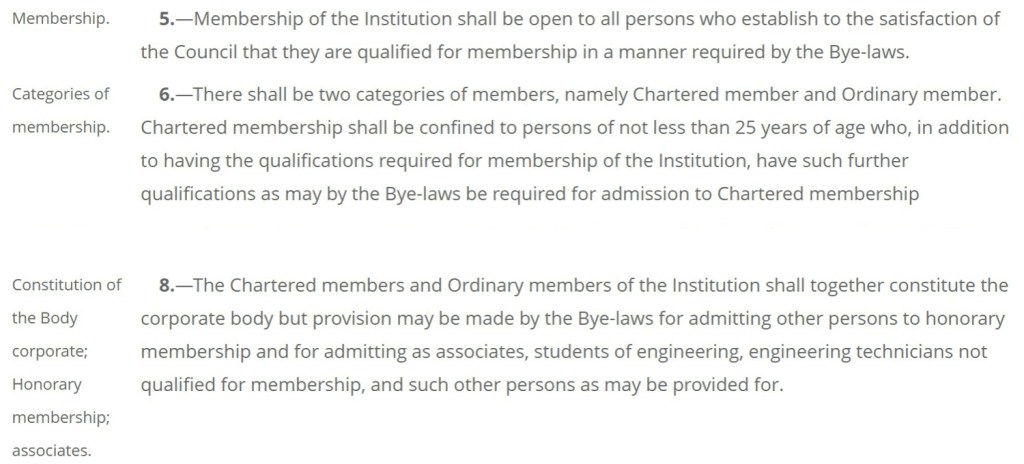
1. The Institution of Civil Engineers of Ireland (Charter Amendment) Act, 1969
Clauses 5, 6, and 8 of the Charter Amendment Act(1969) are particularly instructive in this regard.
2. Engineers Ireland Bye-laws(2012)
Clarity is provided by the definitions in the Engineers Ireland Bye-laws(2012) regarding the types of members that make up the two categories referred to in the Charter Amendment Act(1969). They are as follows:
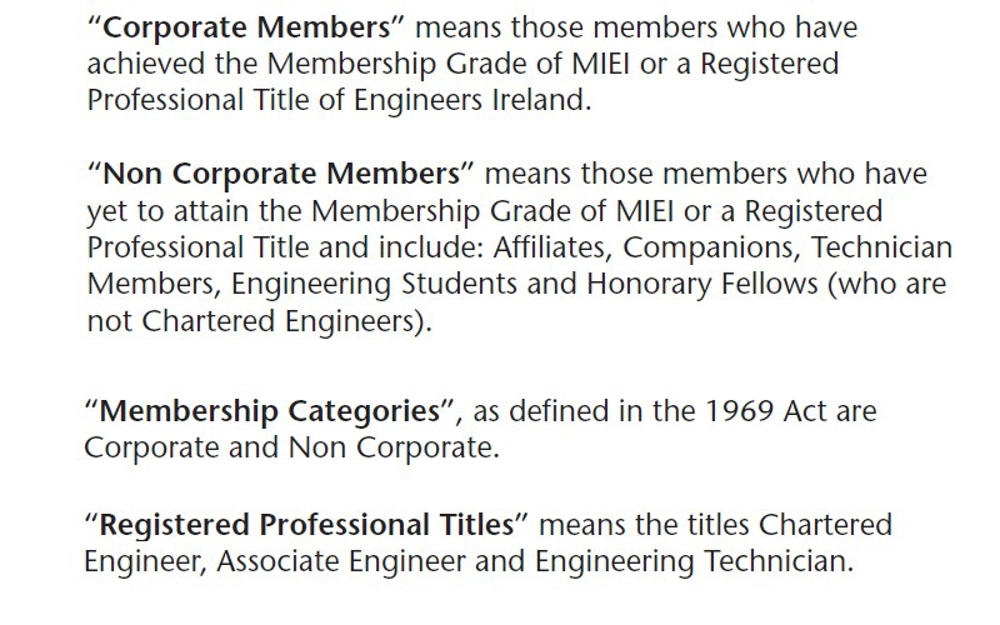
Incidentally Engineers Ireland has included ‘Fellow’ (FIEI) as a registered title on its website, which is not consistent with the definitions in the Engineers Ireland Bye-laws(2012).
If the ‘membership categories’ as defined in the Charter Amendment Act(1969) are Corporate and Non-Corporate, what role does each play in the governance of Engineers Ireland? Again the following Clauses from the Engineers Ireland Bye-laws(2012) are instructive:
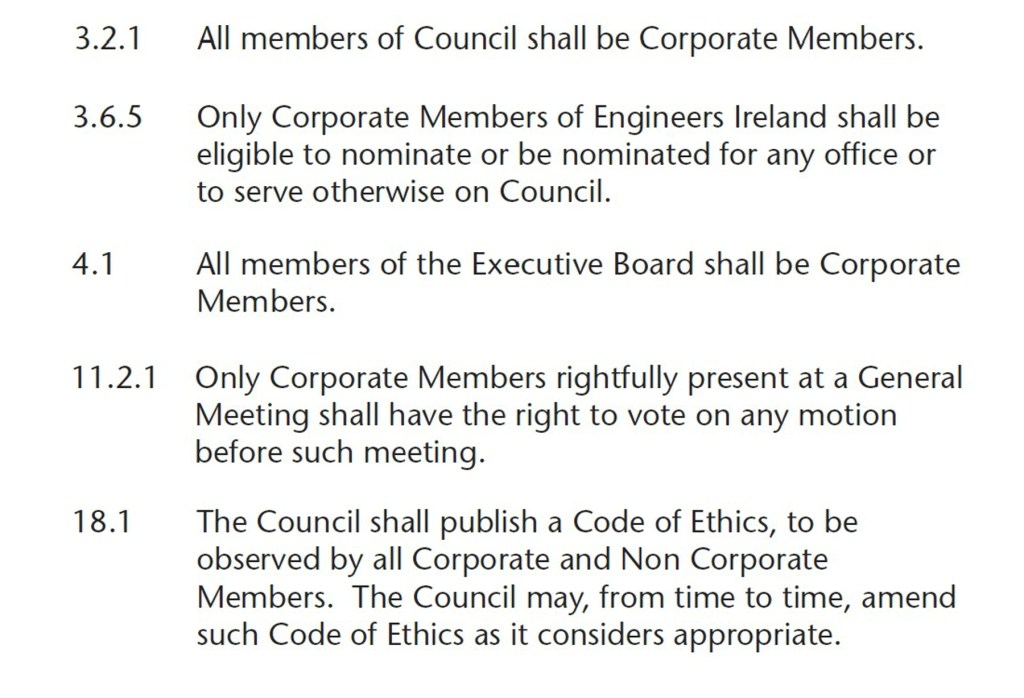
It is, therefore, reasonable to conclude that the governance of the Institution is very much the responsibility of its Corporate Members. Furthermore, in understanding the membership ‘health’ of Engineers Ireland, surely the trends in its Corporate Members would be a good indicator?
Corporate Members
The trends in Corporate Members of Engineers Ireland over the period of 2009-2021 is informative with a cumulative growth of +6.3%. During the same period the staff costs at Engineers Ireland have grown by +52.7% with a +19.5% increase in staff numbers.
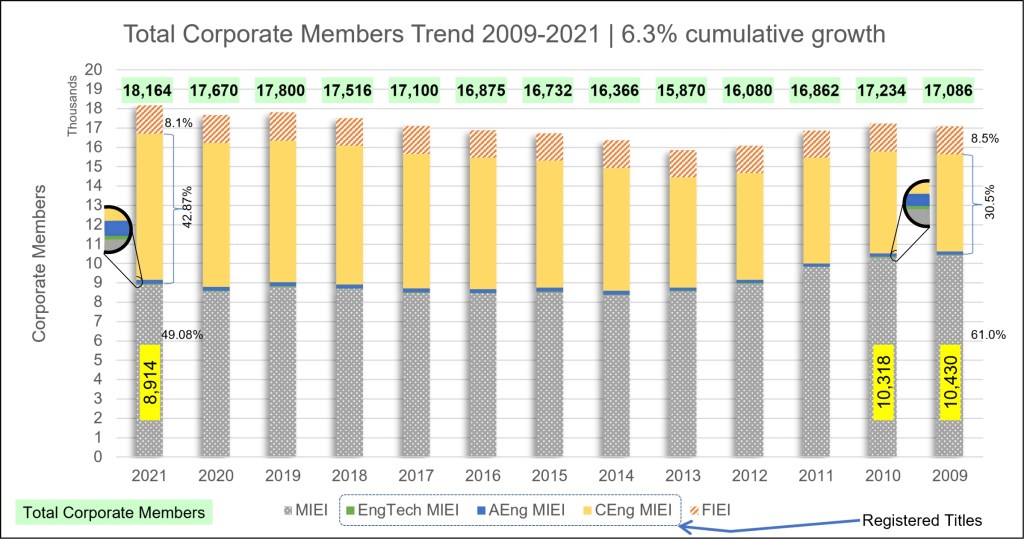
The following are the key insights:
- In 2009, the Registered Titles {Chartered Engineer (CEng), Associated Engineer (AEng), Engineering Technician (EngTech)} accounted for 30.5% of the Corporate Members. They now account for 42.9% of Corporate Members as reported in 2021.
- There has been a small decline (8.5% to 8.1%) in those members who have gone on to be awarded Fellow of Engineers Ireland (FIEI) despite the numbers that receive the ‘gift’ by way of Presidential invitation to Fellow each year.
- The most revealing metric is however, the decline in the number of Ordinary Members (MIEI) over this period. In 2009 there were 10,430 Ordinary Members, (61% of the corporate membership). By 2021, the number of Ordinary Members dropped to 8,914 (49.1% of Corporate Members). The awarding of Registered Titles to Ordinary Members would account for a some of the shift in the make-up of the Corporate Members as highlighted above.
- At the end of 2021 however, the number of Ordinary Members was still 1,516 lower than it was in 2009, and the total corporate membership has only grown by 1,078 in this time period.
In the Engineers Ireland Annual Report 2015, the President (2015-2016) remarked that “measures of the health of our organisation do not fall readily to hand…”, which in hindsight is an extraordinary admission, as the report also noted the retirement of the Director General (2007-2015).
Ronald Cox reminiscing in his publication ‘Called to Serve Two 1969-2018’, highlighted that back in 2009 the Engineers Ireland management team led by the Director General (2007-2015) “set itself the following goals:
- To be the trusted and influential voice of engineering in Ireland by 2012
- To double the fee-paying membership to 35,000 by 2012
- To double its income; and
- To be an organisation that delivers excellence through, and for, its people.”
It is worth noting that those targets were set with the backdrop of the established global financial crisis in 2008. To quote Lewis[4], “By Thursday, September 18th, 2008, however, the big picture had grown unstable that the small picture had become nearly incoherent ……. On Monday, Lehman Brothers had filed for bankruptcy, ….” Carney[5] also reflected on that time; “I distinctly remember how the global financial crisis of 2008 reversed the growing momentum to address climate change, and we lost a precious decade as a result”. In the Engineers Ireland Annual Report 2008, the Director General (2007-2015) wrote “The year just completed has seen an enormous shift in the economic fortunes of Ireland Inc. and undoubtedly we face a number of very difficult years ahead. Our challenge must be to remain completely focused on our goals”.
- By 2012, the data reported in the Engineers Ireland Annual Reports confirmed that the Corporate Members had decreased (-5.9%), rather than the planned growth (+100%) in the same time period, even though membership expansion had been “aided by opening up MIEI to level 7 graduates”.[6]
- In fact, for the period (2009-2015) there was an overall decrease (-2%) in the corporate membership of Engineers Ireland.
In the Engineers Ireland Annual Report 2021, the President (2021-2022) in concluding, remarked that the Director General (2015-2022) “has been a wonderful asset to the organisation during her seven years.…..based on her considerable expertise in planning strategically, building relationships, leading a team and delivering results. She leaves us in a position of great strength in membership numbers, member offerings, finances, organisational capacity and standing with stakeholders.”
This is an extraordinary assessment by the President (2021-2022) in light of the following facts:
- The Ordinary membership was still 1,516 less than it was in 2009.
- There has been a modest cumulative growth (+6.3%) in Corporate Members since 2009.
- Annual staff costs have increased by +52.7% with a +19.5% growth in staff numbers since 2009.
In continuing the presidential address tradition[1] that originated in 1856 with George Willoughby Hemans, a less lofty target was announced by the President (2022-2023) during his Presidential Address on the 29th September 2022 where the ambition is to “retain the graduates of today and target a paying membership of 25,000 in 5 years’ time”. Perhaps, a reversal from the recently adopted culture of secrecy over the last decade to a culture of transparency will be necessary to achieve even this target.
‘Old Chestnuts’
“why only a limited % of qualified Engineers in the country are members of our institution”
The symptoms have been obvious to members for the last decade. The growing disconnect between Engineers Ireland and its Members has only manifested itself publicly with our article ‘Environment, Ethics & Engineers’ highlighting the fact that “the leadership in Engineers Ireland removed all references to sustainable development; excluded any reference to Climate Change and Biodiversity Loss; and, erased the section on members’ obligations to the environment and society from the latest revision to the Code of Ethics(2023)“, even though “Climate action and sustainability were a strong theme in the responses to the 2020 Engineers Ireland member survey. When asked whether engineers have an ethical obligation to tackle climate change and biodiversity loss, 88% agreed.”[7]
“how can we entice a greater number of our members to be more active in Engineers Ireland.”
Our article ‘Engineers Ireland U-turn on ethical obligation to tackle climate change and biodiversity loss’ perhaps provides an insight into how meaningful engagement with Engineers Ireland is hampered by its lack of transparency with the membership: “the President [2022-2023] advised that the documents related to Item 5 (the Code of Ethics Review) ……were not suitable for circulation and should not be circulated outside of Council”.
In the ‘Guidelines on Council Documents for Sector Representatives’ issued to members in 2022, while it does acknowledge that “a Council representative is elected at the AGM of their respective Regional branch or Engineering division from among the committee members”, thus admitting they are representing the committee from which they are elected. Yet the Council member is prohibited from disclosing any of the material to be discussed at the Council meeting. However, “following each Council meeting, [the representative on Council can] update the Committee on agreed matters discussed by the Council including key decisions made”, without having the benefit of input on matters from the committee members they represent to be included in the Council discussions prior to key decisions being taken by Council. Furthermore, in our article ‘Engineers Ireland and similar professional organisations’ we highlight that the “comprehensive study of 18 codes of conduct from similar and disparate organisations in Ireland and overseas” undertaken by Engineers Ireland has not been made available to Members”.
Chances are that the ‘old chestnuts’ will exist as long as the culture that nurtures them remains in power!
[1] Cox, R., “Called to Serve Two 1969-2018”; (2019)
[2] Engineers Ireland Annual Report 2009, Engineers Ireland Annual Report 2021
[3] ICE 2009 results reported in ICE Annual Report 2013, ICE Annual Report 2021
[4] Lewis, M., “The Big Short”; (2011)
[5] Carney, M., “Value(s) – Climate, Credit, Covid and How We Must Focus on What Matters”; (2021)




 Conscientious Observers