

Following on from the recent celebration of ‘International Women’s Day‘, perhaps as a preparation for the upcoming ‘International Women in Engineering Day’ we shine a spotlight on how Engineers Ireland has ‘walked the talk’ over the past number of years.
While not always described as ‘values’, organisations have long recognised the importance of possessing a set of guiding principles. Values, Aristotle observed, “are qualities, human excellence, reflected through our habits, skills, and behaviours”. Collins et al[1] elaborates further, defining values as “the organisation’s essential and enduring tenets – a small set of guiding principles; not to be confused with specific cultural or operating practices; not to be compromised for financial gain or short-term expediency”. They are, therefore, the fundamental beliefs for which an organisation stands.
Engineers Ireland Strategy (2017-2020) sets out the four values ‘Progressive’, ‘Community’, ‘Excellence’, and ‘Trustworthy’ representative of “a commitment to ensure that all our activities are underpinned by four core values”. By trustworthy it state, “we always act with integrity in our dealings with all stakeholders”.
Engineers Ireland Statement of Strategic Intent (2021-2023) also sets out four similar values replacing ‘Progressive’ with ‘Innovation’ and ‘Trustworthy’ with ‘Trust’, stating that its “values represent a commitment to ensure that all [its] activities are underpinned by a promise to approach [its] work with specific behaviours”.
Most definitions of ‘Trust’ ascribe to it a “firm belief in the reliability, truth, or ability of someone or something”.
Women in Engineering
We have already demonstrated in “Environment, Ethics and Engineers” that regardless of the statements published in official Engineers Ireland documents or media sound-bites, what is truly happening, operationally, is something quite different. Unfortunately, the celebration of ‘International Women in Engineering Day’ is no exception.
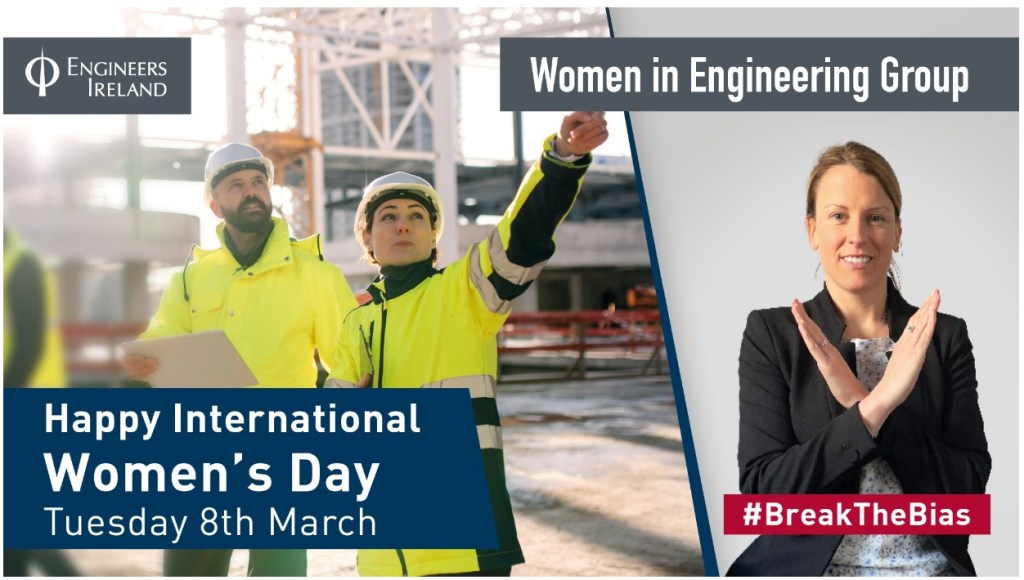
Engineers Ireland, to its credit, formally launched a ‘Women in Engineering Group’ on ‘International Women’s Day’ on 8th March 2021. The Group said, that “other targeted steps like gender-balanced committees and interview panels, more diverse interviewee lists, and a greater mixture across boards and senior management in engineering companies would be effective in supporting the career progression of women engineers” would be on their agenda. The inaugural Chair, herself a Chartered Engineer, stated that “many female engineers work in male-dominated environments such as offices, facilities and sites, and can sometimes face unconscious biases”.
The Director General (2015-2022) of Engineers Ireland, added that “each year International Women’s Day gives us the opportunity to celebrate the contribution women in our industry make around the world”. The following year, recognising ‘Women in Engineering’ on ‘International Women’s Day’ the President (2021-2022) of Engineers Ireland said it was “great to see recognition that there are equal opportunities in the engineering sector, but the fall-off between graduate numbers and women working in the profession requires greater focus and more creative engagement between professional bodies, engineering organisations and the education system”. ‘International Women in Engineering Day’ is celebrated on 23rd June each year and with the theme #BreakTheBias in 2022, Engineers Ireland called for “greater support for female talent”. An extract from that press release reads as follows:
{“International Women in Engineering Day provides us with the opportunity to celebrate the significant contribution women in the engineering sector make around the world. This internationally celebrated day also presents us with an opportunity to reflect, and it is clear that more must be done collectively to carve out pathways and to develop supports to increase the number of female engineers working in industry,” commented Caroline Spillane, Director General of Engineers Ireland. The Director General concluded the press release saying, “by working together, we can nurture our future engineering talent and help female engineers create a clear pathway for progression”.}
Call to Action – whose responsibility?
In summary, we have heard the call to action; ‘work together’, ‘break the bias’, ‘gender-balance’, ‘clear pathway for progression’, but has Engineers Ireland itself provided any career opportunities to women Members of the Institution? If one was to accept the sound-bites expressed at each Engineers Ireland Annual General Meeting in isolation, then the repeated ‘bill of good health’ would be reassuring to the casual observer. However, it is only by evaluating the Engineers Ireland Annual Report in the context of previous annual reports that trends tend to emerge. The following insights are taken from the Engineers Ireland Annual Reports[2] during the tenure of the last Director General (2015-2022).
Break the Bias
The Engineers Ireland Policy Paper, ‘Encouraging more Women to become Engineers‘, published in March 2018, highlights the fact that “many female engineers have serious concerns regarding promotion to senior levels and pay; for example, male engineers are almost twice as likely to work in senior management compared to female engineers.” The policy paper makes it clear that “men and women need to be given the same opportunities. Companies must ensure they are encouraging both women and men to step forward for opportunities and provide a clear career development path for all of their employees, including membership of company boards.”
Each year in the Engineers Ireland Annual Report a list of employees as recorded at the end of the reporting period is published. Members of Engineers Ireland are generally those engineers that have met the criteria to become Ordinary Members (MIEI) and those that have progressed to the registered title of Chartered Engineer (CEng).
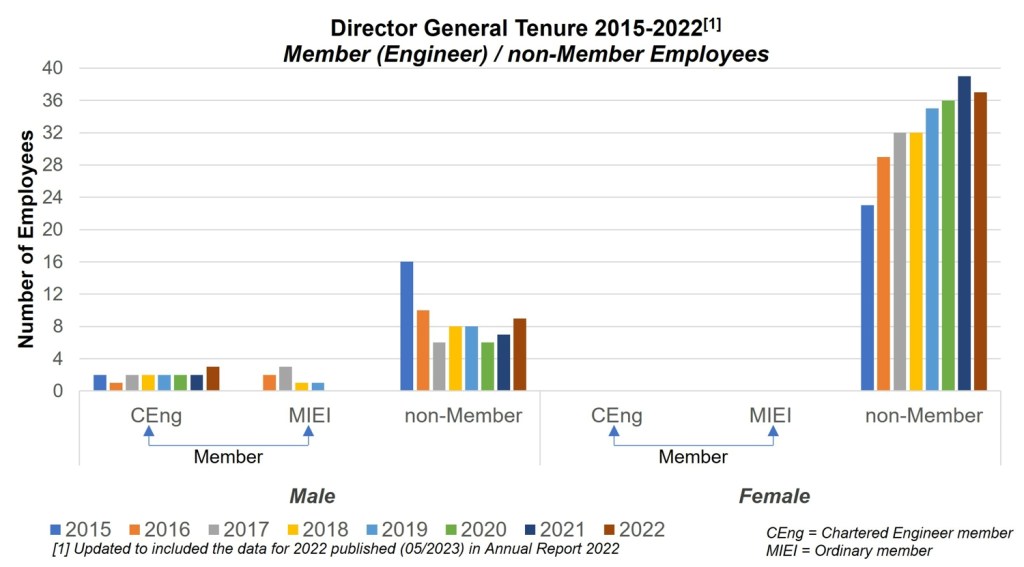
This Figure[3] shows the composition of Engineers Ireland employees from each of the Annual Reports over the seven-year period. What is extraordinary is that not even one woman Member of Engineers Ireland is included in any of the published employee lists during the tenure of the Director General (2015-2022).
Gender Balance
Engineers Ireland sets out its commitment on page 43 in the Engineers Ireland Annual Report 2021: “Engineers Ireland is fully committed to fostering, cultivating and preserving a culture of diversity, equality, and inclusion. The aim is for our workforce to be truly representative of all sections of society, members, and stakeholders, and for each employee to feel respected and able to give their best. Equally all employees are required to take personal and individual responsibility to comply with Engineers Ireland’s policies and practices that provide equality of opportunity for all, and promote dignity and respect for all. In order to proactively meet its commitments, Engineers Ireland formed a cross-organisational Inclusion and Diversity employee group.”

This Figure[3] presents the trend in gender balance during the tenure of the Director General (2015-2022). One can only conclude from this evidence that “conscious bias” is a legacy of this administration.
Renewed Focus
In recent years Engineers Ireland has perfected the ‘Art of Equivocation‘ particularly at its Annual General Meetings. What is inexcusable, however, is knowing these facts, and how well represented women were in decision making positions over this period; a) holding five of the six senior management positions; b) the Director General (2015-2022); and c) two Presidents of Engineers Ireland (2019-2020) and (2021-2022), yet the Institution has continued to offer worthless sound-bites regarding the ‘celebration of women engineers’ that goes unchallenged by its members.
At the Engineers Ireland AGM 2023, held on 1st June 2023, the Director General (2022-), who had previously been the Registrar (2010-2022), without prompting, stated that there were eight staff with engineering qualifications in Engineers Ireland – four women and four men and three are Chartered Engineers. What was confirmed is that the ‘Art of Equivocation‘ persists, regardless. The three staff members of Engineers Ireland that have the Registered Title of Chartered Engineer are men, consistent with the Figure above. The remaining five of these eight staff members, even though they have engineering qualifications, have not considered it to be a benefit to become Members of Engineers Ireland[3].
Is it any wonder that there were no women candidates on the ballot paper for election to Council for the term of office 2023-2024?[3]
Trust is something that is earned. Accountability is something that is required. A renewed focus for the ‘Women in Engineering Group’ perhaps!
[1] Collins, J., Porras, J. “Built to Last”; 1994
[2] Engineers Ireland Annual Reports included: Annual Report 2015, Annual Report 2016, Annual Report 2017, Annual Report 2018, Annual Report 2019, Annual Report 2020, Annual Report 2021.
[3] Article updated 19/06/2023
Featured image courtesy of INWED



 Conscientious Observers